I know Winter's on the outs.
I had planned to do one of these probably in late December, but I didn't.
Just like Autumn, though, Winter brings with it a certain mood that - for whatever reason - makes certain music seem more desirable. Sometimes, it's just because I happened to buy or receive an album in the season in question, and it's some kind of internal and mechanical nostalgia that my brain wants to hear the same music it heard around the same time last year (things get cramped as I buy more music, but it all works out in the end).
I had a tough time with this, because I wanted to do a better job of distinguishing between albums I just happen to want to listen to in the winter vs. albums which actually share some kind of thematic feeling with the season - where I would be showcasing the latter here.
Likewise, it's a little difficult to pick just one album by a particular artist, given that some artists just happen to write a lot of music that sounds wintry to me. I'll probably mention a few alternates here anyway.
For some reason, Winter seems to my mind to be a season of electonics. Electronic music, fused with organic sounds like orchestras and choirs, glockenspiels... that sort of thing. You'll see.
Bjork - Vespertine
Bjork is one of those artists who has a few wintry albums. She explains that she had wanted to capture some of the essence of her native Iceland, using organic sounds as percussion, but programming it digitally. The result on the album she was talking about - Homogenic - and to a much greater extent on Vespertine is music that conjures images of trudging through deep snow or soaring over mountainous icecaps and glaciers. While Homogenic seems to clumsily try to execute that fusion of organic with electronic by nailing it to the back of popsongs - Vespertine eschews the throwbacks to film music, jazz standards, and angry-girl music in favour of structured, but free songs about making love.
Yep. Pretty much every song on the album is, in some way about making love - sometimes a little more explicitly than I'm comfortable with. That said, there's something pretty wintry about fucking. As a child born in August, it's no surprise to me that in the cold of winter, people try to warm up by getting close to eachother... in a sexual sort of way.
Here's one of the more illustrative tracks from Vespertine: "Hidden Place"
Also check out: Pagan Poetry, Aurora, Unison
Radiohead - OK Computer
I wanted to feature Kid A instead, because it's my favourite, but it's not exactly the right choice. Kid A is a dark sort of album, and evokes the feelings of winter you might have while driving through grey slush in a salt-crusted car. That's not exactly what I'm going for here.
On the other hand, its predecessor OK computer is a more lush and atmospheric sort of album that - while still making me think of driving in a salt-encrusted car - makes me think of a brighter snowier time. Perhaps it would be accurate to say that OK Computer is the bright sunny winter day to Kid A's dark, damp winter's night.
On Kid A, singer Thom Yorke's voice haunts the listener, while on OK Computer, it simply soars.
Here's my favourite track from OK Computer, "Subterranean Homesick Alien"
Also check out No Surprises, Airbag, Let Down, The Tourist
BT - This Binary Universe
I want to emphasize just how much I love this album. I discovered it by chance on the last.fm radio service. I had been familiar with Brian Transeau's work as a dance music producer of some renown. I'd heard some remixes. It didn't blow my top.
This album did. This album is not dance music.
For This Binary Universe, BT took elements of film music, orchestral music, and meshed it with glitch music, jazz, breakbeat, ambient, acoustic guitars, soft pianos... a bunch of stuff. As I've mentioned, it perfectly combines electronics and organics in some of the most beautiful and compelling ways. Some tracks are more wintry than others, but overall, the whole album gives one the sense of flying in the night sky and looking down on snow-covered landscapes around the world. The CD even comes with an addition DVD with a 5.1 surround mix and each song gets its own short film to accompany it. It's really something.
Here's one of my favourites from this album: 'Good Morning Kaia' - written for his daughter.
Also try The Internal Locus and The Antikythera Mechanism.
Hybrid - Wide Angle
Few people have heard of Hybrid, for some reason. A friend (who has now gone on to do some pretty decent music himself) introduced me to them ages ago. Once again, they are primarily electronic music producers, but as the name suggests, they create a hybrid of orchestral music and 'nu-skool breaks' as they're known, that provides something lush, beautiful, and often very driving.
On Wide Angle, Hybrid gives their first and, in my opinion, their best example of a winter album and also just a beautiful fusion of orchestral with breakbeat. Much of the cohesiveness of the album relies on the amazing vocal work of frequent David Lynch collaborator Julee Cruise. She's on a number of tracks on the album.
Part of what makes me think of winter with this album is the combination of those string sections with the beats (I'm trying not to repeat myself), in that I imagine myself doing what I've done a number of times while listening to this album: walking through the snow down main street in my home town at a fast pace in order to get where I'm going as fast as possible. The energy of the music makes the briskness of the weather something refreshing and energizing rather than oppressive.
Here's my favourite track from the album, and also one of my favourite songs: "If I Survive" featuring Julee Cruise on vocals.
Also try Dreaming your Dreams, Sniper, and Finished Symphony.
Nine Inch Nails - Still
It's not exactly an official album. Still was released as a bonus disc for the 2001 live album And All That Could Have Been. It only has a limited amount of new material on it, but in many ways, it bridges a gap between the last official album The Fragile, and its live album. Now, most fans have an understanding that Trent Reznor was in a very bad state by the end of recording The Fragile, and was near death due to his addictions to alcohol and drugs by the end of the following tour.
Still is an album that takes some older songs and re-imagines them in a stripped down way, with Reznor on piano a drum machine, and the occasional atmospheric or guitar part.
However, that stuff, while interesting, soft, and introspective isn't really the centrepiece (nor the wintriest part) of the album. The rest of the music is primarily made up of instrumental outtakes from The Fragile, and unused pieces of music meant for Mark Romanek's film One Hour Photo (which ended up using music by Johnny Klimek, who scored Run Lola Run).
Two key tracks from the album which are both very wintry to me are the new vocal song "And All That Could Have Been", (whose lyrics evoke images of snow, ice in order to reflect a love gone cold), and the closing instrumental track "Leaving Hope" whose instrumentation and melody bring to mind the darker side of winter. The isolation, the melancholy, the cold...
Here is Leaving Hope.
Also listen to Adrift and At Peace, Gone Still, and And All that Could Have Been.
Goldfrapp - Felt Mountain
I actually tend to associate Goldfrapp's other albums with winter, more because that is when I bought them and listened to them until I got sick of them. On the other hand, the album Felt Mountain is a different sort of animal than her other albums. This album has been described as a cross between James Bond Themes and UFO movie soundtracks. I don't disagree.
The beautiful string arrangements, oddly sexual and sometimes sinister lyrics and delivery, the subdued, jazzy rhythms. It's very Bond... but then there's something altogether weird and sci-fi about it too.
Now, what makes it wintry? Again, this album is a night-time sort of album (or at least, a very early morning sort of album). But rather than the harshness of winter, the album evokes the warmer moments, sitting by a fire and looking out at snowflakes illuminated by streetlights... poofy stuff like that. Of course, I have to add that the combination of electronics with an organic sort of sound is very much what makes me think of winter when I hear it.
Here's a favourite of mine from the album: "Pilots"
Also try Lovely Head, Paper Bag, Human, and Utopia (the whole album, really).
Rush - Power Windows
Power Windows comes from a strange, transitory time in Rush's career. While they had previously cut a niche for themselves as philosophically charged, masterful prog-rockers, their early 80s album Signals saw them drop the extended rock numbers in favour of synthesizer driven rock songs in a more new-wave style.
Power Windows came in 1985, the third of these albums laden with synthesizer. And, while I had initially been put out by the transition to synth-rock, as soon as I heard the opener "The Big Money" I had to rethink things.
It's a punch in the face. It's a snow-plow of awesome, charging through a snow-bank and revealing the best band ever, playing behind it.
Okay, that was a little silly.
But, something about the cold tone of the synthesizers coupled with Alex Lifeson's reverbed guitar makes me think of ice and snow. To me, it's as though the drab winter slush of the previous album Grace Under Pressure is being buried in fluffy snow, and the band has come out to play.
Whatever. Just listen to this: "The Big Money"
Also try Grand Designs, Manhattan Project, and Territories.
(try to ignore how ridiculous and 80s they look).
Sigur Ros - ( )
Technically, every Sigur Ros album sounds pretty wintry. They come from Iceland, like Bjork, and they also employ a combination of electronics (less so than Bjork) with strings and ethereal atmospheres. The album ( ) is unique in that none of its songs have official titles, and the album itself is named with a pair of parentheses. The liner notes are empty, and you're encouraged to write your own. The lyrics are a nonsensical made-up language called 'Vonlenska' (which translates loosely to 'Hopelandish' - a combination between hope, icelanic, and english).
There is a duality to the album, in that the first four tracks are more uplifting, and the latter four are much darker and melancholy.
The album is very wintry, with the album art showing images of what appear to be dead, leafless tree branches, the sound of feet trudging through snow, the ethereal drone of bowed guitar, Jonsi's soaring and drifting falsetto...
It's all very beautiful.
Even the music video for the first track (unofficially known as "Vaka") has winter imagery, with a bit of an ironic twist.
Also check out Track 3, Track 6 and Track 8.
M83 - Before the Dawn Heals Us
This album was a bit hard to choose, because I know that apart from Saturdays = Youth, an album which I included in my Autumn Music post, most M83 albums are very wintry.
They create a wall of electronic sound, burying ethereal and dreamy vocals underneath layers of drum and keyboard. The french duo create soundscapes that make one think of a cold winter city at night. Snow sparkling under street lights while cars speed by. Like others on this list, Before the Dawn Heals Us is a reflection of the darker, sadder side of winter. Its choirs and long sad ambient pieces tend to echo the emotions of the person who feels isolated and cold in winter.
I remember, one of the first times I heard the album, I was on a bus packed with strangers and carrying a heavy suitcase, and moments of the album nearly brought me to tears.
Here's one of the better tracks: "Don't Save us From the Flames"
Also try Teen Angst, Farewell/Goodbye, Safe
Well... that was a lot of music.
Enjoy.
Showing posts with label album review. Show all posts
Showing posts with label album review. Show all posts
Friday, February 4, 2011

Friday, October 8, 2010
Autumn Music
I knew it was officially fall this year when I changed out the group of CDs I bring to work with me for a new set. I usually do that when I reorganize my main CD collection (which is now numbering at around 360 official albums). Normally, though, I might leave a good portion of the previous set in my case, rather than swapping them all out. I guess it's just time for my leaves to change... or some other suitably purple phrase.
Not only did I simply change out my artists and albums, I switched genres completely. I went from the loud progressive rock music of late summer (like Rush, Frank Zappa, Dream Theater, and tool) to a more ethereal set of genres like post-rock, dreampop, shoegaze, and other things that make older people go "huh?"
The changing of the seasons has always influenced my choice of music. Or maybe the seasons influence my mood, which influence my music choices. I might feel a breeze and have a longing to hear a certain song, or I'll see the colour of a leaf, and think "the soundtrack to this leaf is this song."
So, here's a bit of an autumnal music swatch for you, as far as I see it - taken directly from my set of CDs that I brought to work with me today.
Radiohead - "In Rainbows"
This album is an autumnal album for me for a few reasons. It has a type of organic mesh between real instruments and electronics that is warm, but harsh. Many of the songs take a dreamy, ethereal tone which lends itself to the quality of light that one sees peeking through the branches of trees as the leaves change. Some songs might make you want to dance through piles of leaves while others are suited for walking in a stiff breeze, or sitting on a porch in the cooler air.
Here's a video for my favourite track from the album "House of Cards":
Air - "Talkie Walkie"
With a name like Air, you would naturally assume (and assume correctly) that the French duo produces music of a breezy, ephemeral, dreamlike quality. None of the tracks on the album are particularly uptempo, but many are certainly upbeat and lackadaisical. Likewise, many are melancholy. With more moving songs like 'Run' and whimsical tracks like 'Surfing on a Rocket' or the instrumental 'Alpha Beta Gaga" the group manages to capture the more enchanting qualities of autumn while underscoring its inherent link with death and loss in the end of summer and the coming of winter.
Here's one of my favourites from this album, "Cherry Blossom Girl":
M83 - "Saturdays = Youth"
Even the artwork on this album suggests autumn. The teens on the cover appear in a field sporting unusual attire like low-key halloween costumes, cast in tones of yellow, brown, green, and red. Likewise, many of the songs feature a halloween sort of theme without being overly campy. The album has a theme of youth and love, and the fascination with exploring death and its link with love - all of which are thematically linked with the season of autumn and halloween as well (and the equinox, I suppose). these themes pop up in songs like "Graveyard girl" and "Kim and Jessie".
Here's a video for "Kim and Jessie." It's not the official one, but it'll do:
Manitoba (Caribou) - "Up in Flames"
I forgot as I was typing out that bandname that the artist had to change it from Manitoba to Caribou a few years back due to some absolutely ridiculous litigation that I may discuss another time. Just like on the M83 album, the art on this album is full of fall colours. And similar to the Radiohead album, this album is a mess of organic sounds and electronic sounds fused together. The opening track "I've lived on a dirt road all my life" conjures images of my own childhood living in a town full of dirt roads, bordered by trees of changing colours. I say a 'mess' of organic sounds, because, to many, that's what it would sound like. There's a base of simple melodies and layers of folky guitar, but suddenly, and without warning, comes a drum beat that just makes you want to move. For me, the whole album acts like a sort of dancing celebration of the end of summer and the beginning of fall, how summer's heat is up in flames leaving time for the evening to come, and with it the cool of fall in the morning.
Here's the track "Kid, you'll Move Mountains," for your listening pleasure:
Friday, December 11, 2009
Concept Album Series Part I:
Electric Light Orchestra's "Time" (1981)
A lot of people dismiss Electric Light Orchestra (ELO) as disco tripe, or a Beatles rip-off band.
Admittedly, Jeff Lynne’s fusion of orchestral music with progressive rock and pop music was, at times, quite obviously both. Other times, it was something more.
It can’t be denied that Mr. Lynne could write a great pop song, regardless of how schlocktastic the lyrics were, or how derivative his music sounded (of himself, or of others). By the 8os, ELO had run the gauntlet from orchestral and string-oriented music, to a more rock’n'roll sound, to blatant disco, culminating with 1979′s Discovery (Disco? Very!).
It can’t be denied that Mr. Lynne could write a great pop song, regardless of how schlocktastic the lyrics were, or how derivative his music sounded (of himself, or of others). By the 8os, ELO had run the gauntlet from orchestral and string-oriented music, to a more rock’n'roll sound, to blatant disco, culminating with 1979′s Discovery (Disco? Very!).
1981′s Time, on the other hand was a whole new direction, with a clear leaning toward new wave music.
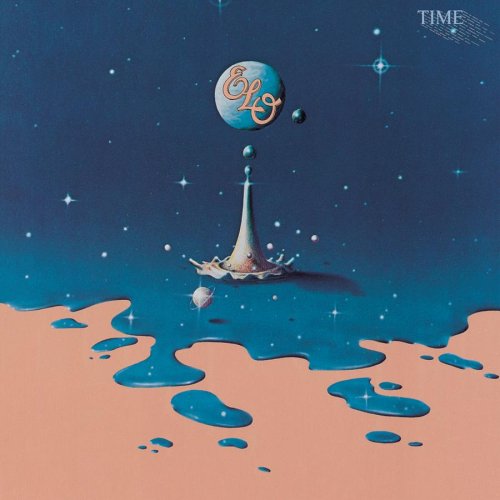 |
| The cover of Electric Light Orchestra's Time |
Okay, the concept:
A man is hanging out with his girlfriend when some people from the future come and take him away to the to their time: the late 21st century (Wait, that’s this one!). Upon arriving there, he wanders around all sadly, missing his girl. Eventually, it is revealed that the future sucks, and that the future-beings wanted him to see how shitty life is going to be if he doesn’t change things back in 1981. So after some exciting space-opera antics, they send him back, because he’s not a “21st Century Man” and in the end, he holds on to his dreams (in french, even!) and the future-beings look on, telling him how lucky he is to have learned whatever lesson they taught him.
A man is hanging out with his girlfriend when some people from the future come and take him away to the to their time: the late 21st century (Wait, that’s this one!). Upon arriving there, he wanders around all sadly, missing his girl. Eventually, it is revealed that the future sucks, and that the future-beings wanted him to see how shitty life is going to be if he doesn’t change things back in 1981. So after some exciting space-opera antics, they send him back, because he’s not a “21st Century Man” and in the end, he holds on to his dreams (in french, even!) and the future-beings look on, telling him how lucky he is to have learned whatever lesson they taught him.
Okay, the plot's a bit weak - but you can fill in the holes with your imaginaaaation!
Now, the focus of the album isn’t so much on how the ravages of time lay waste to all as it is on how embracing technology leads to a cold and inhuman future. I’m no Luddite, and I suspect that neither was Jeff Lynne, considering that apart from his guitar and a small amount of string arrangement, the album is pretty much drum machines and synthesizers all over. So, you have to realize that the whole thing is just a story, which – if fleshed out to a much greater extent – could be pretty compelling (or could be the 1985 movie Back to the Future).
So, what makes this concept album great, despite my admitting that it’s a flawed album? Oh, I don’t know… Good tunes? Seriously, though, let’s get a little more in-depth, so I can flesh out what is not fleshed out, maybe.
The opener ‘Prologue’ sums up the whole thing pretty nicely. Basically, it says that if you could see what lies beyond the border of your waking mind (the future), then you’d be pretty happy that you can’t go there. Unfortunately for the protagonist, the voice in the prologue (a vocoder; which was a pretty prominent continuity element on this and the previous two albums) belongs to the future-beings, and they have a message from another time: “the future sucks, but you’re coming back there with us, loser.”
Obviously, this would upset any normal person. The first real track on the album "Twilight" explains how upset this dude is. It’s also pretty much the best song on the album, and the most reminiscent of the hallowed Out of the Blue era ELO (it has a similar keyboard-heavy, upbeat quality to that of "Turn to Stone"). The song describes the experience of having some people come down from the sky telling you lies and then taking you away to the future without so much as a ‘by-your-leave.’
So, he’s kind of peeved. What do they do to assuage his woes? They give him a sexy robot girlfriend in "Yours truly, 2095." He professes that he still loves his lady, and that until the day he can’t go without some sexy lovins, he’ll leave this robot chick alone.
Following that, we get two musical throwbacks with little relation to the story apart from an implicit “it sucks being out here in the future” message: "Ticket to the Moon" and "The Way Life's Meant to Be." However, the latter of the two is very catchy, features a not-bad impersonation of Roy Orbison, and has a bit of exposition involving a rhyme of ‘avenue’ with the phrase ‘say or do’ (a feat!).
One of the standouts on the album in terms of music and progression of story is the song "Rain is Falling" which features a pretty powerful vocal from Mr. Lynne, and some nice imagery. Again, the song is extra-good because it is reminiscent of the "concerto for a rainy day" (a suite of songs on Out of the Blue, culminating in the classic "Mr. Blue Sky"‘). However, it surpasses many of the songs in that suite, in terms of greatness.
The gist of the song is that the people in the future have never seen rain for some reason, and then it rains, causing everyone to freak out (which is not very important to the plot). However, there is mention of a brand new time transporter with which he might get home, but unfortunately, despite their best efforts, they can’t figure out how the hell to get him back, so he’s stuck in the rain.
To put it bluntly, "From the End of the World" is a disco mess. It’s not contributing anything, plot-wise, and the music is riding a dead horse all the way to disco town.
To put it bluntly, "From the End of the World" is a disco mess. It’s not contributing anything, plot-wise, and the music is riding a dead horse all the way to disco town.
However, the following track "The Lights Go Down" takes the amusing turn of seeing the protagonist reach the aforementioned point at which having sex with a robot seems desirable. Apart from the joy that comes with conjuring images of man-vs-robot coitus, it’s a pretty fun reggae-ish song with a catchy sing-along chorus (more in the style of UB40 than Bob Marley).
"Here is the News" hints vaguely that the protagonist’s desire to return to 1981 to see his girlfriend has led to his attempted escape from Satellite 2 (a location mentioned in an earlier track). The song has a driving beat and some sexy synthesizer use as well as some phoney (but realistic) news report audio pastiche all over it.
Another of my favourite tracks on the album is the pseudo-finale "21st Century Man" which is narrated by the future-beings again (sans vocoder), and explains that even with all the grand designs of the future, he’s not happy to have been taken out of his own time, so they’re sending him back, because he’s not a 21st century man. The chorus has an emotionally evocative progression which builds in intensity as the song progresses, and lyrically gets to the heart of the issue: Nobody likes to be taken away from the things they really love, no matter what the future may hold.
Following that is a semi-superfluous track called "Hold on Tight" (which became a minor hit). One can imagine that it’s the sort of song where, if it were a musical, the entire cast would come out and be all “Yeah! even the dead people are here to sing the last happy song!” (see also: Les Misérables).
As I mentioned, occasionally the lyrics switch to French for no apparent reason. Blondie pulled it off on "Sunday Girl," so, I guess I can’t complain. Anyhoo, picture, if you will, a dude in a time-machine singing this happy song about holding on tight to your dreams, so that when you’re taken to the future by a bunch of space-jerks, you don’t get depressed.
The closing track “Epilogue” is the sort of thing where one might imagine the future-beings using some fancy glass device apropos of a Logan’s Run-esque sci-fi romp, looking regretfully upon the protagonist as he lives happily ever after. They warn that he should be so happy to get his wish… to go home after they abducted him, the jerks. And I guess somewhere in the middle he saved the future from sucking, maybe.
Now, I’d also like to mention two additional conceptually linked B-sides from the album “When Time Stood Still” and “Julie Don’t Live Here Anymore.” The former is another depressing ballad, describing a moment at which time has stood still, which is ultimately very sad because it’s a very lonely existence.
The latter is on par with "Twilight" in terms of music. The content is interesting (and reminds one of the second half of Back to the Future II) in that the protagonist runs around trying to find his girlfriend’s house after having been transported through time, only to discover that she doesn’t live there, because… well, it’s the future, isn’t it? She moved away. As I said, it’s musically a great pop song, with bombastic descending piano lines and a catchy 60s pop revival style, tempered by 80s new wave. Both tracks would have been welcome additions to the album and were fortunately included in the 2001 remastered release.
So, now that I’ve wasted a pile of text on a track-by-track review and plot outline, I suppose that what makes this a great concept album is not so much a richness of plot (because half the songs are barely related) as it is a potential for richness of plot. That is, the plot is vague enough, but also interesting enough for me to think a more detailed one up with the power of my imagination (insert finger-wiggle here).
So, now that I’ve wasted a pile of text on a track-by-track review and plot outline, I suppose that what makes this a great concept album is not so much a richness of plot (because half the songs are barely related) as it is a potential for richness of plot. That is, the plot is vague enough, but also interesting enough for me to think a more detailed one up with the power of my imagination (insert finger-wiggle here).
Additionally, I refer to my initial statement: good tunes.
The album is hook-tastic. It has good vocal performances, great melodies, and very well produced, as one might expect from Jeff Lynne (who also produced the Beatles’ Anthology's unfinished John Lennon singles “Free as a Bird” and “Real Love” ).
… So… That’s it. I like ELO’s Time.
… So… That’s it. I like ELO’s Time.
… good tunes.
Tuesday, May 6, 2008
Album Review: Ashes Divide – “Keep Telling Myself It’s Alright”
 |
| Ashes Divide - Keep Telling Myself It's Alright |
Billy Howerdel began as a guitar tech for tool, which led to his association with Maynard James Keenan, and the formation of A Perfect Circle, a supergroup with music composed by Howerdel, and lyrics and vocals by Keenan.
Together, they produced two albums, and one (somewhat mediocre) cover-album of anti-war songs, released to coincide with the 2004 election. With the immanent release of tool’s 10,000 Days MJK had to return to his original band, leaving Billy with the time to write new music for his own solo project called ASHES dIVIDE.
Fans of A Perfect Circle will find more common ground between Ashes Divide’s Keep Telling Myself It’s Alright and APC’s first album Mer de Noms than with their later material. For those who like their alt-metal harder than it is progressive, this will be a positive attribute.
KTMiA (as I shall now refer to it) is strong first solo effort, which is to be expected from the composer behind such classics as the APC tunes “Judith” and “Weak and Powerless.” It is clear that Howerdel’s composition and arrangement are the backbone of all of his musical efforts.
That said, having grown accustomed to MJK’s powerful voice, it is somewhat jarring to be confronted with Howerdel’s somewhat more mainstream style of singing. His dynamics are less apparent, and he leans toward the more awkward tones of popular punk-rock, on what may seem a few too many occasions. This shouldn't be a problem for newcomers, or for those who are willing to take the time to grow into Howerdel’s new musical voice.
Standout Tracks: Defamed, Enemies, The Stone
The album’s opener “Stripped Away” drags a little. Its pace is powerful but slow, and in that sense, it does not immediately grab one's attention. It isn’t until the bridge that the energy of the song is truly conveyed to the extent that it ought to be. The heavy guitars drop out, and Howerdel’s voice wavers with the strength of his vocal performance, recalling Freddie Mercury, in a faint sort of way. Unfortunately, this demonstration of ability is only a brief respite from what is an otherwise drab song.
“Denial Waits” begins in a plaintive lyrical moan by Howerdel, over a quick beat by super-drummer Josh Freese. Before long, the emotional rawness we should have been hearing in the previous track appears somewhat abruptly, but welcome nevertheless amid a powerful blast of music.
“Too Late” is another heavy slow-mover, but its melancholy verses don’t feel draggy like they did in “Stripped Away.” Musically, it's an appropriate mish-mash of the styles found on APC's first two albums. However, in this song, we see a first example of where Howerdel’s composition exceeds his vocal prowess to a detrimental effect. After a typically good Howerdel guitar solo, a great musical bridge emerges, but it's dragged down by poor lyricism and just as poor singing by Howerdel
“Forever Can Be” is another melancholy slow-mover (there appear to be a lot of these). Its chorus is given some grounding by a piano melody that matches the melancholy tone. As if to make up for the icky bridge in “Too Late” the lyrics of the chorus are more interesting: “Forever can be something to believe in. This was one of those times.” It suggests disappointment, and failure, despite optimism. Interspersed throughout is an intriguing little guitar melody which has east-asian hints, or perhaps medieval elements, which add some flavour to the first real ear-catching track on the album.
“Defamed” almost sounds like a rock cover of The Postal Service. The chord progression is light and minor, but hopeful. The lyrics are a little silly considering the weight of the previous songs’ content. Despite this, the song is cohesive, and catchy. Its upbeat tempo and strong drum-work by Freese make it danceable and contribute to what is ostensibly a great rock song.
When the allmusicguide refers to “Enemies” as overeager, one can see why, given its introductory guitar riffs. However, heavy punk drums and the return of that style of emotion-laden power-vocals mean that “Enemies” is going to be a fast-paced ass-kicker of a song. The key-change in the latter half of the song is particularly engaging.
“A Wish” seems noodly at first, with a simple piano melody and sporadic drums, which build into a cohesive roll. Billy’s close-mic’d vocals are low and wispy. The lyrics are simple and personal, without collapsing too far into purple prose. The groove maintained by the drums, and the piano melody hold the song together for its short duration.
“Ritual” takes a similar approach, vocally, to “A Wish.” A mysterious set of counter-melodies gives this one a little more to chew on for listeners. Without much difference between this and the previous song, musically, it maintains the melancholy mood with some more good music.
At last, the single “The Stone” follows, with a somewhat clichéd intro that bursts into yet more clichéd, but faster riffs (cool dissonance notwithstanding). Freese’s driving beat helps build anticipation of the chorus, which is a dramatic burst of swelling guitars that borrow (if only subconsciously) from film scores. Unfortunately, after hearing the chorus, the following verses make one impatient at having to wade through them before the chorus returns. Despite that, the chorus of "The Stone" carries the song (and perhaps even the the whole album) by it’s sheer might. Yes, might.
“The Prey” feels more electronic than any other track on the album, borrowing some of its melodic style from the mainstream. An interesting feature of the track is a slightly detuned, high-pitched guitar line which plays intriguing little melodic riffs over top of the rhythm tracks and vocals. It works as a strong counter-point to Billy’s vocals. The mood of the song is more of joyous than any of the other tracks.
The final track “Sword” has a dissonant piano melody as its intro, with a subtle cello (which grows to become less subtle) just underneath. The cello switches to the top of the mix, sounding vaguely offkey over the piano’s dissonant tones. The intro gives way to a driving, throbbing bassline which recalls the Tapeworm toss-away “Passive” that was released on APC’s cover-album eMotive. The entire song takes this approach, and hits hard, throbbing and driving until it all drops away about five minutes in revealing a gentle vocal line over top of the same introductory piano melody, which sounds more beautiful the second time around.
Subscribe to:
Posts (Atom)