Thursday, September 29, 2011

Friday, February 4, 2011
Winter Music
I know Winter's on the outs.
I had planned to do one of these probably in late December, but I didn't.
Just like Autumn, though, Winter brings with it a certain mood that - for whatever reason - makes certain music seem more desirable. Sometimes, it's just because I happened to buy or receive an album in the season in question, and it's some kind of internal and mechanical nostalgia that my brain wants to hear the same music it heard around the same time last year (things get cramped as I buy more music, but it all works out in the end).
I had a tough time with this, because I wanted to do a better job of distinguishing between albums I just happen to want to listen to in the winter vs. albums which actually share some kind of thematic feeling with the season - where I would be showcasing the latter here.
Likewise, it's a little difficult to pick just one album by a particular artist, given that some artists just happen to write a lot of music that sounds wintry to me. I'll probably mention a few alternates here anyway.
For some reason, Winter seems to my mind to be a season of electonics. Electronic music, fused with organic sounds like orchestras and choirs, glockenspiels... that sort of thing. You'll see.
Bjork - Vespertine
Bjork is one of those artists who has a few wintry albums. She explains that she had wanted to capture some of the essence of her native Iceland, using organic sounds as percussion, but programming it digitally. The result on the album she was talking about - Homogenic - and to a much greater extent on Vespertine is music that conjures images of trudging through deep snow or soaring over mountainous icecaps and glaciers. While Homogenic seems to clumsily try to execute that fusion of organic with electronic by nailing it to the back of popsongs - Vespertine eschews the throwbacks to film music, jazz standards, and angry-girl music in favour of structured, but free songs about making love.
Yep. Pretty much every song on the album is, in some way about making love - sometimes a little more explicitly than I'm comfortable with. That said, there's something pretty wintry about fucking. As a child born in August, it's no surprise to me that in the cold of winter, people try to warm up by getting close to eachother... in a sexual sort of way.
Here's one of the more illustrative tracks from Vespertine: "Hidden Place"
Also check out: Pagan Poetry, Aurora, Unison
Radiohead - OK Computer
I wanted to feature Kid A instead, because it's my favourite, but it's not exactly the right choice. Kid A is a dark sort of album, and evokes the feelings of winter you might have while driving through grey slush in a salt-crusted car. That's not exactly what I'm going for here.
On the other hand, its predecessor OK computer is a more lush and atmospheric sort of album that - while still making me think of driving in a salt-encrusted car - makes me think of a brighter snowier time. Perhaps it would be accurate to say that OK Computer is the bright sunny winter day to Kid A's dark, damp winter's night.
On Kid A, singer Thom Yorke's voice haunts the listener, while on OK Computer, it simply soars.
Here's my favourite track from OK Computer, "Subterranean Homesick Alien"
Also check out No Surprises, Airbag, Let Down, The Tourist
BT - This Binary Universe
I want to emphasize just how much I love this album. I discovered it by chance on the last.fm radio service. I had been familiar with Brian Transeau's work as a dance music producer of some renown. I'd heard some remixes. It didn't blow my top.
This album did. This album is not dance music.
For This Binary Universe, BT took elements of film music, orchestral music, and meshed it with glitch music, jazz, breakbeat, ambient, acoustic guitars, soft pianos... a bunch of stuff. As I've mentioned, it perfectly combines electronics and organics in some of the most beautiful and compelling ways. Some tracks are more wintry than others, but overall, the whole album gives one the sense of flying in the night sky and looking down on snow-covered landscapes around the world. The CD even comes with an addition DVD with a 5.1 surround mix and each song gets its own short film to accompany it. It's really something.
Here's one of my favourites from this album: 'Good Morning Kaia' - written for his daughter.
Also try The Internal Locus and The Antikythera Mechanism.
Hybrid - Wide Angle
Few people have heard of Hybrid, for some reason. A friend (who has now gone on to do some pretty decent music himself) introduced me to them ages ago. Once again, they are primarily electronic music producers, but as the name suggests, they create a hybrid of orchestral music and 'nu-skool breaks' as they're known, that provides something lush, beautiful, and often very driving.
On Wide Angle, Hybrid gives their first and, in my opinion, their best example of a winter album and also just a beautiful fusion of orchestral with breakbeat. Much of the cohesiveness of the album relies on the amazing vocal work of frequent David Lynch collaborator Julee Cruise. She's on a number of tracks on the album.
Part of what makes me think of winter with this album is the combination of those string sections with the beats (I'm trying not to repeat myself), in that I imagine myself doing what I've done a number of times while listening to this album: walking through the snow down main street in my home town at a fast pace in order to get where I'm going as fast as possible. The energy of the music makes the briskness of the weather something refreshing and energizing rather than oppressive.
Here's my favourite track from the album, and also one of my favourite songs: "If I Survive" featuring Julee Cruise on vocals.
Also try Dreaming your Dreams, Sniper, and Finished Symphony.
Nine Inch Nails - Still
It's not exactly an official album. Still was released as a bonus disc for the 2001 live album And All That Could Have Been. It only has a limited amount of new material on it, but in many ways, it bridges a gap between the last official album The Fragile, and its live album. Now, most fans have an understanding that Trent Reznor was in a very bad state by the end of recording The Fragile, and was near death due to his addictions to alcohol and drugs by the end of the following tour.
Still is an album that takes some older songs and re-imagines them in a stripped down way, with Reznor on piano a drum machine, and the occasional atmospheric or guitar part.
However, that stuff, while interesting, soft, and introspective isn't really the centrepiece (nor the wintriest part) of the album. The rest of the music is primarily made up of instrumental outtakes from The Fragile, and unused pieces of music meant for Mark Romanek's film One Hour Photo (which ended up using music by Johnny Klimek, who scored Run Lola Run).
Two key tracks from the album which are both very wintry to me are the new vocal song "And All That Could Have Been", (whose lyrics evoke images of snow, ice in order to reflect a love gone cold), and the closing instrumental track "Leaving Hope" whose instrumentation and melody bring to mind the darker side of winter. The isolation, the melancholy, the cold...
Here is Leaving Hope.
Also listen to Adrift and At Peace, Gone Still, and And All that Could Have Been.
Goldfrapp - Felt Mountain
I actually tend to associate Goldfrapp's other albums with winter, more because that is when I bought them and listened to them until I got sick of them. On the other hand, the album Felt Mountain is a different sort of animal than her other albums. This album has been described as a cross between James Bond Themes and UFO movie soundtracks. I don't disagree.
The beautiful string arrangements, oddly sexual and sometimes sinister lyrics and delivery, the subdued, jazzy rhythms. It's very Bond... but then there's something altogether weird and sci-fi about it too.
Now, what makes it wintry? Again, this album is a night-time sort of album (or at least, a very early morning sort of album). But rather than the harshness of winter, the album evokes the warmer moments, sitting by a fire and looking out at snowflakes illuminated by streetlights... poofy stuff like that. Of course, I have to add that the combination of electronics with an organic sort of sound is very much what makes me think of winter when I hear it.
Here's a favourite of mine from the album: "Pilots"
Also try Lovely Head, Paper Bag, Human, and Utopia (the whole album, really).
Rush - Power Windows
Power Windows comes from a strange, transitory time in Rush's career. While they had previously cut a niche for themselves as philosophically charged, masterful prog-rockers, their early 80s album Signals saw them drop the extended rock numbers in favour of synthesizer driven rock songs in a more new-wave style.
Power Windows came in 1985, the third of these albums laden with synthesizer. And, while I had initially been put out by the transition to synth-rock, as soon as I heard the opener "The Big Money" I had to rethink things.
It's a punch in the face. It's a snow-plow of awesome, charging through a snow-bank and revealing the best band ever, playing behind it.
Okay, that was a little silly.
But, something about the cold tone of the synthesizers coupled with Alex Lifeson's reverbed guitar makes me think of ice and snow. To me, it's as though the drab winter slush of the previous album Grace Under Pressure is being buried in fluffy snow, and the band has come out to play.
Whatever. Just listen to this: "The Big Money"
Also try Grand Designs, Manhattan Project, and Territories.
(try to ignore how ridiculous and 80s they look).
Sigur Ros - ( )
Technically, every Sigur Ros album sounds pretty wintry. They come from Iceland, like Bjork, and they also employ a combination of electronics (less so than Bjork) with strings and ethereal atmospheres. The album ( ) is unique in that none of its songs have official titles, and the album itself is named with a pair of parentheses. The liner notes are empty, and you're encouraged to write your own. The lyrics are a nonsensical made-up language called 'Vonlenska' (which translates loosely to 'Hopelandish' - a combination between hope, icelanic, and english).
There is a duality to the album, in that the first four tracks are more uplifting, and the latter four are much darker and melancholy.
The album is very wintry, with the album art showing images of what appear to be dead, leafless tree branches, the sound of feet trudging through snow, the ethereal drone of bowed guitar, Jonsi's soaring and drifting falsetto...
It's all very beautiful.
Even the music video for the first track (unofficially known as "Vaka") has winter imagery, with a bit of an ironic twist.
Also check out Track 3, Track 6 and Track 8.
M83 - Before the Dawn Heals Us
This album was a bit hard to choose, because I know that apart from Saturdays = Youth, an album which I included in my Autumn Music post, most M83 albums are very wintry.
They create a wall of electronic sound, burying ethereal and dreamy vocals underneath layers of drum and keyboard. The french duo create soundscapes that make one think of a cold winter city at night. Snow sparkling under street lights while cars speed by. Like others on this list, Before the Dawn Heals Us is a reflection of the darker, sadder side of winter. Its choirs and long sad ambient pieces tend to echo the emotions of the person who feels isolated and cold in winter.
I remember, one of the first times I heard the album, I was on a bus packed with strangers and carrying a heavy suitcase, and moments of the album nearly brought me to tears.
Here's one of the better tracks: "Don't Save us From the Flames"
Also try Teen Angst, Farewell/Goodbye, Safe
Well... that was a lot of music.
Enjoy.
I had planned to do one of these probably in late December, but I didn't.
Just like Autumn, though, Winter brings with it a certain mood that - for whatever reason - makes certain music seem more desirable. Sometimes, it's just because I happened to buy or receive an album in the season in question, and it's some kind of internal and mechanical nostalgia that my brain wants to hear the same music it heard around the same time last year (things get cramped as I buy more music, but it all works out in the end).
I had a tough time with this, because I wanted to do a better job of distinguishing between albums I just happen to want to listen to in the winter vs. albums which actually share some kind of thematic feeling with the season - where I would be showcasing the latter here.
Likewise, it's a little difficult to pick just one album by a particular artist, given that some artists just happen to write a lot of music that sounds wintry to me. I'll probably mention a few alternates here anyway.
For some reason, Winter seems to my mind to be a season of electonics. Electronic music, fused with organic sounds like orchestras and choirs, glockenspiels... that sort of thing. You'll see.
Bjork - Vespertine
Bjork is one of those artists who has a few wintry albums. She explains that she had wanted to capture some of the essence of her native Iceland, using organic sounds as percussion, but programming it digitally. The result on the album she was talking about - Homogenic - and to a much greater extent on Vespertine is music that conjures images of trudging through deep snow or soaring over mountainous icecaps and glaciers. While Homogenic seems to clumsily try to execute that fusion of organic with electronic by nailing it to the back of popsongs - Vespertine eschews the throwbacks to film music, jazz standards, and angry-girl music in favour of structured, but free songs about making love.
Yep. Pretty much every song on the album is, in some way about making love - sometimes a little more explicitly than I'm comfortable with. That said, there's something pretty wintry about fucking. As a child born in August, it's no surprise to me that in the cold of winter, people try to warm up by getting close to eachother... in a sexual sort of way.
Here's one of the more illustrative tracks from Vespertine: "Hidden Place"
Also check out: Pagan Poetry, Aurora, Unison
Radiohead - OK Computer
I wanted to feature Kid A instead, because it's my favourite, but it's not exactly the right choice. Kid A is a dark sort of album, and evokes the feelings of winter you might have while driving through grey slush in a salt-crusted car. That's not exactly what I'm going for here.
On the other hand, its predecessor OK computer is a more lush and atmospheric sort of album that - while still making me think of driving in a salt-encrusted car - makes me think of a brighter snowier time. Perhaps it would be accurate to say that OK Computer is the bright sunny winter day to Kid A's dark, damp winter's night.
On Kid A, singer Thom Yorke's voice haunts the listener, while on OK Computer, it simply soars.
Here's my favourite track from OK Computer, "Subterranean Homesick Alien"
Also check out No Surprises, Airbag, Let Down, The Tourist
BT - This Binary Universe
I want to emphasize just how much I love this album. I discovered it by chance on the last.fm radio service. I had been familiar with Brian Transeau's work as a dance music producer of some renown. I'd heard some remixes. It didn't blow my top.
This album did. This album is not dance music.
For This Binary Universe, BT took elements of film music, orchestral music, and meshed it with glitch music, jazz, breakbeat, ambient, acoustic guitars, soft pianos... a bunch of stuff. As I've mentioned, it perfectly combines electronics and organics in some of the most beautiful and compelling ways. Some tracks are more wintry than others, but overall, the whole album gives one the sense of flying in the night sky and looking down on snow-covered landscapes around the world. The CD even comes with an addition DVD with a 5.1 surround mix and each song gets its own short film to accompany it. It's really something.
Here's one of my favourites from this album: 'Good Morning Kaia' - written for his daughter.
Also try The Internal Locus and The Antikythera Mechanism.
Hybrid - Wide Angle
Few people have heard of Hybrid, for some reason. A friend (who has now gone on to do some pretty decent music himself) introduced me to them ages ago. Once again, they are primarily electronic music producers, but as the name suggests, they create a hybrid of orchestral music and 'nu-skool breaks' as they're known, that provides something lush, beautiful, and often very driving.
On Wide Angle, Hybrid gives their first and, in my opinion, their best example of a winter album and also just a beautiful fusion of orchestral with breakbeat. Much of the cohesiveness of the album relies on the amazing vocal work of frequent David Lynch collaborator Julee Cruise. She's on a number of tracks on the album.
Part of what makes me think of winter with this album is the combination of those string sections with the beats (I'm trying not to repeat myself), in that I imagine myself doing what I've done a number of times while listening to this album: walking through the snow down main street in my home town at a fast pace in order to get where I'm going as fast as possible. The energy of the music makes the briskness of the weather something refreshing and energizing rather than oppressive.
Here's my favourite track from the album, and also one of my favourite songs: "If I Survive" featuring Julee Cruise on vocals.
Also try Dreaming your Dreams, Sniper, and Finished Symphony.
Nine Inch Nails - Still
It's not exactly an official album. Still was released as a bonus disc for the 2001 live album And All That Could Have Been. It only has a limited amount of new material on it, but in many ways, it bridges a gap between the last official album The Fragile, and its live album. Now, most fans have an understanding that Trent Reznor was in a very bad state by the end of recording The Fragile, and was near death due to his addictions to alcohol and drugs by the end of the following tour.
Still is an album that takes some older songs and re-imagines them in a stripped down way, with Reznor on piano a drum machine, and the occasional atmospheric or guitar part.
However, that stuff, while interesting, soft, and introspective isn't really the centrepiece (nor the wintriest part) of the album. The rest of the music is primarily made up of instrumental outtakes from The Fragile, and unused pieces of music meant for Mark Romanek's film One Hour Photo (which ended up using music by Johnny Klimek, who scored Run Lola Run).
Two key tracks from the album which are both very wintry to me are the new vocal song "And All That Could Have Been", (whose lyrics evoke images of snow, ice in order to reflect a love gone cold), and the closing instrumental track "Leaving Hope" whose instrumentation and melody bring to mind the darker side of winter. The isolation, the melancholy, the cold...
Here is Leaving Hope.
Also listen to Adrift and At Peace, Gone Still, and And All that Could Have Been.
Goldfrapp - Felt Mountain
I actually tend to associate Goldfrapp's other albums with winter, more because that is when I bought them and listened to them until I got sick of them. On the other hand, the album Felt Mountain is a different sort of animal than her other albums. This album has been described as a cross between James Bond Themes and UFO movie soundtracks. I don't disagree.
The beautiful string arrangements, oddly sexual and sometimes sinister lyrics and delivery, the subdued, jazzy rhythms. It's very Bond... but then there's something altogether weird and sci-fi about it too.
Now, what makes it wintry? Again, this album is a night-time sort of album (or at least, a very early morning sort of album). But rather than the harshness of winter, the album evokes the warmer moments, sitting by a fire and looking out at snowflakes illuminated by streetlights... poofy stuff like that. Of course, I have to add that the combination of electronics with an organic sort of sound is very much what makes me think of winter when I hear it.
Here's a favourite of mine from the album: "Pilots"
Also try Lovely Head, Paper Bag, Human, and Utopia (the whole album, really).
Rush - Power Windows
Power Windows comes from a strange, transitory time in Rush's career. While they had previously cut a niche for themselves as philosophically charged, masterful prog-rockers, their early 80s album Signals saw them drop the extended rock numbers in favour of synthesizer driven rock songs in a more new-wave style.
Power Windows came in 1985, the third of these albums laden with synthesizer. And, while I had initially been put out by the transition to synth-rock, as soon as I heard the opener "The Big Money" I had to rethink things.
It's a punch in the face. It's a snow-plow of awesome, charging through a snow-bank and revealing the best band ever, playing behind it.
Okay, that was a little silly.
But, something about the cold tone of the synthesizers coupled with Alex Lifeson's reverbed guitar makes me think of ice and snow. To me, it's as though the drab winter slush of the previous album Grace Under Pressure is being buried in fluffy snow, and the band has come out to play.
Whatever. Just listen to this: "The Big Money"
Also try Grand Designs, Manhattan Project, and Territories.
(try to ignore how ridiculous and 80s they look).
Sigur Ros - ( )
Technically, every Sigur Ros album sounds pretty wintry. They come from Iceland, like Bjork, and they also employ a combination of electronics (less so than Bjork) with strings and ethereal atmospheres. The album ( ) is unique in that none of its songs have official titles, and the album itself is named with a pair of parentheses. The liner notes are empty, and you're encouraged to write your own. The lyrics are a nonsensical made-up language called 'Vonlenska' (which translates loosely to 'Hopelandish' - a combination between hope, icelanic, and english).
There is a duality to the album, in that the first four tracks are more uplifting, and the latter four are much darker and melancholy.
The album is very wintry, with the album art showing images of what appear to be dead, leafless tree branches, the sound of feet trudging through snow, the ethereal drone of bowed guitar, Jonsi's soaring and drifting falsetto...
It's all very beautiful.
Even the music video for the first track (unofficially known as "Vaka") has winter imagery, with a bit of an ironic twist.
Also check out Track 3, Track 6 and Track 8.
M83 - Before the Dawn Heals Us
This album was a bit hard to choose, because I know that apart from Saturdays = Youth, an album which I included in my Autumn Music post, most M83 albums are very wintry.
They create a wall of electronic sound, burying ethereal and dreamy vocals underneath layers of drum and keyboard. The french duo create soundscapes that make one think of a cold winter city at night. Snow sparkling under street lights while cars speed by. Like others on this list, Before the Dawn Heals Us is a reflection of the darker, sadder side of winter. Its choirs and long sad ambient pieces tend to echo the emotions of the person who feels isolated and cold in winter.
I remember, one of the first times I heard the album, I was on a bus packed with strangers and carrying a heavy suitcase, and moments of the album nearly brought me to tears.
Here's one of the better tracks: "Don't Save us From the Flames"
Also try Teen Angst, Farewell/Goodbye, Safe
Well... that was a lot of music.
Enjoy.
Friday, October 8, 2010
Autumn Music
I knew it was officially fall this year when I changed out the group of CDs I bring to work with me for a new set. I usually do that when I reorganize my main CD collection (which is now numbering at around 360 official albums). Normally, though, I might leave a good portion of the previous set in my case, rather than swapping them all out. I guess it's just time for my leaves to change... or some other suitably purple phrase.
Not only did I simply change out my artists and albums, I switched genres completely. I went from the loud progressive rock music of late summer (like Rush, Frank Zappa, Dream Theater, and tool) to a more ethereal set of genres like post-rock, dreampop, shoegaze, and other things that make older people go "huh?"
The changing of the seasons has always influenced my choice of music. Or maybe the seasons influence my mood, which influence my music choices. I might feel a breeze and have a longing to hear a certain song, or I'll see the colour of a leaf, and think "the soundtrack to this leaf is this song."
So, here's a bit of an autumnal music swatch for you, as far as I see it - taken directly from my set of CDs that I brought to work with me today.
Radiohead - "In Rainbows"
This album is an autumnal album for me for a few reasons. It has a type of organic mesh between real instruments and electronics that is warm, but harsh. Many of the songs take a dreamy, ethereal tone which lends itself to the quality of light that one sees peeking through the branches of trees as the leaves change. Some songs might make you want to dance through piles of leaves while others are suited for walking in a stiff breeze, or sitting on a porch in the cooler air.
Here's a video for my favourite track from the album "House of Cards":
Air - "Talkie Walkie"
With a name like Air, you would naturally assume (and assume correctly) that the French duo produces music of a breezy, ephemeral, dreamlike quality. None of the tracks on the album are particularly uptempo, but many are certainly upbeat and lackadaisical. Likewise, many are melancholy. With more moving songs like 'Run' and whimsical tracks like 'Surfing on a Rocket' or the instrumental 'Alpha Beta Gaga" the group manages to capture the more enchanting qualities of autumn while underscoring its inherent link with death and loss in the end of summer and the coming of winter.
Here's one of my favourites from this album, "Cherry Blossom Girl":
M83 - "Saturdays = Youth"
Even the artwork on this album suggests autumn. The teens on the cover appear in a field sporting unusual attire like low-key halloween costumes, cast in tones of yellow, brown, green, and red. Likewise, many of the songs feature a halloween sort of theme without being overly campy. The album has a theme of youth and love, and the fascination with exploring death and its link with love - all of which are thematically linked with the season of autumn and halloween as well (and the equinox, I suppose). these themes pop up in songs like "Graveyard girl" and "Kim and Jessie".
Here's a video for "Kim and Jessie." It's not the official one, but it'll do:
Manitoba (Caribou) - "Up in Flames"
I forgot as I was typing out that bandname that the artist had to change it from Manitoba to Caribou a few years back due to some absolutely ridiculous litigation that I may discuss another time. Just like on the M83 album, the art on this album is full of fall colours. And similar to the Radiohead album, this album is a mess of organic sounds and electronic sounds fused together. The opening track "I've lived on a dirt road all my life" conjures images of my own childhood living in a town full of dirt roads, bordered by trees of changing colours. I say a 'mess' of organic sounds, because, to many, that's what it would sound like. There's a base of simple melodies and layers of folky guitar, but suddenly, and without warning, comes a drum beat that just makes you want to move. For me, the whole album acts like a sort of dancing celebration of the end of summer and the beginning of fall, how summer's heat is up in flames leaving time for the evening to come, and with it the cool of fall in the morning.
Here's the track "Kid, you'll Move Mountains," for your listening pleasure:
Not only did I simply change out my artists and albums, I switched genres completely. I went from the loud progressive rock music of late summer (like Rush, Frank Zappa, Dream Theater, and tool) to a more ethereal set of genres like post-rock, dreampop, shoegaze, and other things that make older people go "huh?"
The changing of the seasons has always influenced my choice of music. Or maybe the seasons influence my mood, which influence my music choices. I might feel a breeze and have a longing to hear a certain song, or I'll see the colour of a leaf, and think "the soundtrack to this leaf is this song."
So, here's a bit of an autumnal music swatch for you, as far as I see it - taken directly from my set of CDs that I brought to work with me today.
Radiohead - "In Rainbows"
This album is an autumnal album for me for a few reasons. It has a type of organic mesh between real instruments and electronics that is warm, but harsh. Many of the songs take a dreamy, ethereal tone which lends itself to the quality of light that one sees peeking through the branches of trees as the leaves change. Some songs might make you want to dance through piles of leaves while others are suited for walking in a stiff breeze, or sitting on a porch in the cooler air.
Here's a video for my favourite track from the album "House of Cards":
Air - "Talkie Walkie"
With a name like Air, you would naturally assume (and assume correctly) that the French duo produces music of a breezy, ephemeral, dreamlike quality. None of the tracks on the album are particularly uptempo, but many are certainly upbeat and lackadaisical. Likewise, many are melancholy. With more moving songs like 'Run' and whimsical tracks like 'Surfing on a Rocket' or the instrumental 'Alpha Beta Gaga" the group manages to capture the more enchanting qualities of autumn while underscoring its inherent link with death and loss in the end of summer and the coming of winter.
Here's one of my favourites from this album, "Cherry Blossom Girl":
M83 - "Saturdays = Youth"
Even the artwork on this album suggests autumn. The teens on the cover appear in a field sporting unusual attire like low-key halloween costumes, cast in tones of yellow, brown, green, and red. Likewise, many of the songs feature a halloween sort of theme without being overly campy. The album has a theme of youth and love, and the fascination with exploring death and its link with love - all of which are thematically linked with the season of autumn and halloween as well (and the equinox, I suppose). these themes pop up in songs like "Graveyard girl" and "Kim and Jessie".
Here's a video for "Kim and Jessie." It's not the official one, but it'll do:
Manitoba (Caribou) - "Up in Flames"
I forgot as I was typing out that bandname that the artist had to change it from Manitoba to Caribou a few years back due to some absolutely ridiculous litigation that I may discuss another time. Just like on the M83 album, the art on this album is full of fall colours. And similar to the Radiohead album, this album is a mess of organic sounds and electronic sounds fused together. The opening track "I've lived on a dirt road all my life" conjures images of my own childhood living in a town full of dirt roads, bordered by trees of changing colours. I say a 'mess' of organic sounds, because, to many, that's what it would sound like. There's a base of simple melodies and layers of folky guitar, but suddenly, and without warning, comes a drum beat that just makes you want to move. For me, the whole album acts like a sort of dancing celebration of the end of summer and the beginning of fall, how summer's heat is up in flames leaving time for the evening to come, and with it the cool of fall in the morning.
Here's the track "Kid, you'll Move Mountains," for your listening pleasure:
Friday, December 11, 2009
Concept Album Series Part I:
Electric Light Orchestra's "Time" (1981)
A lot of people dismiss Electric Light Orchestra (ELO) as disco tripe, or a Beatles rip-off band.
Admittedly, Jeff Lynne’s fusion of orchestral music with progressive rock and pop music was, at times, quite obviously both. Other times, it was something more.
It can’t be denied that Mr. Lynne could write a great pop song, regardless of how schlocktastic the lyrics were, or how derivative his music sounded (of himself, or of others). By the 8os, ELO had run the gauntlet from orchestral and string-oriented music, to a more rock’n'roll sound, to blatant disco, culminating with 1979′s Discovery (Disco? Very!).
It can’t be denied that Mr. Lynne could write a great pop song, regardless of how schlocktastic the lyrics were, or how derivative his music sounded (of himself, or of others). By the 8os, ELO had run the gauntlet from orchestral and string-oriented music, to a more rock’n'roll sound, to blatant disco, culminating with 1979′s Discovery (Disco? Very!).
1981′s Time, on the other hand was a whole new direction, with a clear leaning toward new wave music.
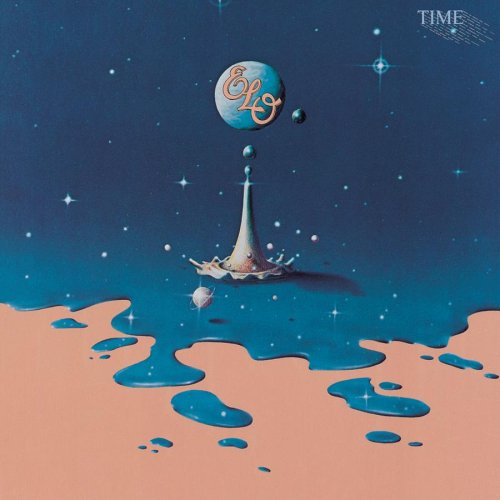 |
| The cover of Electric Light Orchestra's Time |
Okay, the concept:
A man is hanging out with his girlfriend when some people from the future come and take him away to the to their time: the late 21st century (Wait, that’s this one!). Upon arriving there, he wanders around all sadly, missing his girl. Eventually, it is revealed that the future sucks, and that the future-beings wanted him to see how shitty life is going to be if he doesn’t change things back in 1981. So after some exciting space-opera antics, they send him back, because he’s not a “21st Century Man” and in the end, he holds on to his dreams (in french, even!) and the future-beings look on, telling him how lucky he is to have learned whatever lesson they taught him.
A man is hanging out with his girlfriend when some people from the future come and take him away to the to their time: the late 21st century (Wait, that’s this one!). Upon arriving there, he wanders around all sadly, missing his girl. Eventually, it is revealed that the future sucks, and that the future-beings wanted him to see how shitty life is going to be if he doesn’t change things back in 1981. So after some exciting space-opera antics, they send him back, because he’s not a “21st Century Man” and in the end, he holds on to his dreams (in french, even!) and the future-beings look on, telling him how lucky he is to have learned whatever lesson they taught him.
Okay, the plot's a bit weak - but you can fill in the holes with your imaginaaaation!
Now, the focus of the album isn’t so much on how the ravages of time lay waste to all as it is on how embracing technology leads to a cold and inhuman future. I’m no Luddite, and I suspect that neither was Jeff Lynne, considering that apart from his guitar and a small amount of string arrangement, the album is pretty much drum machines and synthesizers all over. So, you have to realize that the whole thing is just a story, which – if fleshed out to a much greater extent – could be pretty compelling (or could be the 1985 movie Back to the Future).
So, what makes this concept album great, despite my admitting that it’s a flawed album? Oh, I don’t know… Good tunes? Seriously, though, let’s get a little more in-depth, so I can flesh out what is not fleshed out, maybe.
The opener ‘Prologue’ sums up the whole thing pretty nicely. Basically, it says that if you could see what lies beyond the border of your waking mind (the future), then you’d be pretty happy that you can’t go there. Unfortunately for the protagonist, the voice in the prologue (a vocoder; which was a pretty prominent continuity element on this and the previous two albums) belongs to the future-beings, and they have a message from another time: “the future sucks, but you’re coming back there with us, loser.”
Obviously, this would upset any normal person. The first real track on the album "Twilight" explains how upset this dude is. It’s also pretty much the best song on the album, and the most reminiscent of the hallowed Out of the Blue era ELO (it has a similar keyboard-heavy, upbeat quality to that of "Turn to Stone"). The song describes the experience of having some people come down from the sky telling you lies and then taking you away to the future without so much as a ‘by-your-leave.’
So, he’s kind of peeved. What do they do to assuage his woes? They give him a sexy robot girlfriend in "Yours truly, 2095." He professes that he still loves his lady, and that until the day he can’t go without some sexy lovins, he’ll leave this robot chick alone.
Following that, we get two musical throwbacks with little relation to the story apart from an implicit “it sucks being out here in the future” message: "Ticket to the Moon" and "The Way Life's Meant to Be." However, the latter of the two is very catchy, features a not-bad impersonation of Roy Orbison, and has a bit of exposition involving a rhyme of ‘avenue’ with the phrase ‘say or do’ (a feat!).
One of the standouts on the album in terms of music and progression of story is the song "Rain is Falling" which features a pretty powerful vocal from Mr. Lynne, and some nice imagery. Again, the song is extra-good because it is reminiscent of the "concerto for a rainy day" (a suite of songs on Out of the Blue, culminating in the classic "Mr. Blue Sky"‘). However, it surpasses many of the songs in that suite, in terms of greatness.
The gist of the song is that the people in the future have never seen rain for some reason, and then it rains, causing everyone to freak out (which is not very important to the plot). However, there is mention of a brand new time transporter with which he might get home, but unfortunately, despite their best efforts, they can’t figure out how the hell to get him back, so he’s stuck in the rain.
To put it bluntly, "From the End of the World" is a disco mess. It’s not contributing anything, plot-wise, and the music is riding a dead horse all the way to disco town.
To put it bluntly, "From the End of the World" is a disco mess. It’s not contributing anything, plot-wise, and the music is riding a dead horse all the way to disco town.
However, the following track "The Lights Go Down" takes the amusing turn of seeing the protagonist reach the aforementioned point at which having sex with a robot seems desirable. Apart from the joy that comes with conjuring images of man-vs-robot coitus, it’s a pretty fun reggae-ish song with a catchy sing-along chorus (more in the style of UB40 than Bob Marley).
"Here is the News" hints vaguely that the protagonist’s desire to return to 1981 to see his girlfriend has led to his attempted escape from Satellite 2 (a location mentioned in an earlier track). The song has a driving beat and some sexy synthesizer use as well as some phoney (but realistic) news report audio pastiche all over it.
Another of my favourite tracks on the album is the pseudo-finale "21st Century Man" which is narrated by the future-beings again (sans vocoder), and explains that even with all the grand designs of the future, he’s not happy to have been taken out of his own time, so they’re sending him back, because he’s not a 21st century man. The chorus has an emotionally evocative progression which builds in intensity as the song progresses, and lyrically gets to the heart of the issue: Nobody likes to be taken away from the things they really love, no matter what the future may hold.
Following that is a semi-superfluous track called "Hold on Tight" (which became a minor hit). One can imagine that it’s the sort of song where, if it were a musical, the entire cast would come out and be all “Yeah! even the dead people are here to sing the last happy song!” (see also: Les Misérables).
Another of my favourite tracks on the album is the pseudo-finale "21st Century Man" which is narrated by the future-beings again (sans vocoder), and explains that even with all the grand designs of the future, he’s not happy to have been taken out of his own time, so they’re sending him back, because he’s not a 21st century man. The chorus has an emotionally evocative progression which builds in intensity as the song progresses, and lyrically gets to the heart of the issue: Nobody likes to be taken away from the things they really love, no matter what the future may hold.
Following that is a semi-superfluous track called "Hold on Tight" (which became a minor hit). One can imagine that it’s the sort of song where, if it were a musical, the entire cast would come out and be all “Yeah! even the dead people are here to sing the last happy song!” (see also: Les Misérables).
As I mentioned, occasionally the lyrics switch to French for no apparent reason. Blondie pulled it off on "Sunday Girl," so, I guess I can’t complain. Anyhoo, picture, if you will, a dude in a time-machine singing this happy song about holding on tight to your dreams, so that when you’re taken to the future by a bunch of space-jerks, you don’t get depressed.
The closing track “Epilogue” is the sort of thing where one might imagine the future-beings using some fancy glass device apropos of a Logan’s Run-esque sci-fi romp, looking regretfully upon the protagonist as he lives happily ever after. They warn that he should be so happy to get his wish… to go home after they abducted him, the jerks. And I guess somewhere in the middle he saved the future from sucking, maybe.
Now, I’d also like to mention two additional conceptually linked B-sides from the album “When Time Stood Still” and “Julie Don’t Live Here Anymore.” The former is another depressing ballad, describing a moment at which time has stood still, which is ultimately very sad because it’s a very lonely existence.
The closing track “Epilogue” is the sort of thing where one might imagine the future-beings using some fancy glass device apropos of a Logan’s Run-esque sci-fi romp, looking regretfully upon the protagonist as he lives happily ever after. They warn that he should be so happy to get his wish… to go home after they abducted him, the jerks. And I guess somewhere in the middle he saved the future from sucking, maybe.
Now, I’d also like to mention two additional conceptually linked B-sides from the album “When Time Stood Still” and “Julie Don’t Live Here Anymore.” The former is another depressing ballad, describing a moment at which time has stood still, which is ultimately very sad because it’s a very lonely existence.
The latter is on par with "Twilight" in terms of music. The content is interesting (and reminds one of the second half of Back to the Future II) in that the protagonist runs around trying to find his girlfriend’s house after having been transported through time, only to discover that she doesn’t live there, because… well, it’s the future, isn’t it? She moved away. As I said, it’s musically a great pop song, with bombastic descending piano lines and a catchy 60s pop revival style, tempered by 80s new wave. Both tracks would have been welcome additions to the album and were fortunately included in the 2001 remastered release.
So, now that I’ve wasted a pile of text on a track-by-track review and plot outline, I suppose that what makes this a great concept album is not so much a richness of plot (because half the songs are barely related) as it is a potential for richness of plot. That is, the plot is vague enough, but also interesting enough for me to think a more detailed one up with the power of my imagination (insert finger-wiggle here).
So, now that I’ve wasted a pile of text on a track-by-track review and plot outline, I suppose that what makes this a great concept album is not so much a richness of plot (because half the songs are barely related) as it is a potential for richness of plot. That is, the plot is vague enough, but also interesting enough for me to think a more detailed one up with the power of my imagination (insert finger-wiggle here).
Additionally, I refer to my initial statement: good tunes.
The album is hook-tastic. It has good vocal performances, great melodies, and very well produced, as one might expect from Jeff Lynne (who also produced the Beatles’ Anthology's unfinished John Lennon singles “Free as a Bird” and “Real Love” ).
… So… That’s it. I like ELO’s Time.
… So… That’s it. I like ELO’s Time.
… good tunes.
Every album should be a concept album
Almost a year ago (when I began writing this particular entry), I went through my entire CD collection and arranged it in alphabetical (by artist) and chronological (by release date) order. Turns out, I have a lot of CDs. Somewhere in the vicinity of 350, not including mixed CDs and my own, humble recordings.
Anyhoo, if you were to look at my CD collection, you’d see that a LOT of the albums are by the same artists. Why is this? Because despite the vastness of my collection, my tastes are not all that varied or eclectic. The one thing that ties many of the bands and albums together, that keeps them in my pile is the prevalence of conceptual continuity in the band’s work. Conceptual continuity refers to a pervading similarity and consistency of theme, message, musical motifs, etc from album to album.
Unsurprisingly, one of my favourite genres of music is progressive rock, a genre which often makes use of conceptual continuity, overtly or subtly. As such, one of the staples of progressive rock throughout its existence is the concept album.
Let’s take a minute to define a concept album.
Anyhoo, if you were to look at my CD collection, you’d see that a LOT of the albums are by the same artists. Why is this? Because despite the vastness of my collection, my tastes are not all that varied or eclectic. The one thing that ties many of the bands and albums together, that keeps them in my pile is the prevalence of conceptual continuity in the band’s work. Conceptual continuity refers to a pervading similarity and consistency of theme, message, musical motifs, etc from album to album.

Unsurprisingly, one of my favourite genres of music is progressive rock, a genre which often makes use of conceptual continuity, overtly or subtly. As such, one of the staples of progressive rock throughout its existence is the concept album.
Let’s take a minute to define a concept album.
Here’s what wikipedia says:
“In popular music, a concept album is an album that is “unified by a theme, which can be instrumental, compositional, narrative, or lyrical”. Commonly, concept albums tend to incorporate preconceived musical or lyrical ideas rather than being improvised or composed in the studio, with all songs contributing to a single overall theme or unified story. This is in contrast to the standard practice of an artist or group releasing an album consisting of a number of unconnected (lyrically or otherwise) songs performed by the artist. Given that the suggestion of something as vague as an overall mood often tags a work as being a concept album, a precise definition of the term proves problematic.”
Now, in that definition lies the very reason why I love concept albums: a unifying theme or narrative. I like music to tell a story. I like continuity. I feel like an album full of songs that aren’t connected might as well be sold off song by song as mp3s. Now, you know how I feel about the “music single” mentality and digital music.
Long story short: a single is disposable, and cannot possibly be representative of a good musician’s work, because commercial viability is apparently more important than nuance, subtlety, production value, etc. Likewise, the mp3, “shuffle” and, playlist schema propagates and perpetuates that single mentality, removing songs from their primary context: the album. The crime of removing a song from its context is especially heinous when the album happens to be a concept album.
Before I get too lost in that topic, let’s talk about unifying themes and narratives. Some say that every song tells a story. That might be true, but is it a simple boy-meets-girl story, or is it just a chapter in a larger story that has some kind of resonating relevance? Is i t just one small story being told in the grander story that is the concept album?
Before I get too lost in that topic, let’s talk about unifying themes and narratives. Some say that every song tells a story. That might be true, but is it a simple boy-meets-girl story, or is it just a chapter in a larger story that has some kind of resonating relevance? Is i t just one small story being told in the grander story that is the concept album?
In order to explore a few of these themes and narratives, I'm going to do an ongoing and sporadic series on concept albums in the form of combined literary analyses / music reviews.
Friday, April 3, 2009
The Rab Townsend Video Experience Part III: Concept Albums for the Goodtime Have!
Concept Albums are for the good time have!
In which Rab fails to fail in every respect, especially when it comes to failing to say “so that was” after every song. Additionally featuring the waxing on and off poetic with respect to what makes a good concept album, who has made a good concept album, and why you suck for not having seen “The Last Unicorn.”
Song List:
Song List:
1. Electric Light Orchestra – Prologue/Twilight (4:57)
2. Marilyn Manson – Kinderfeld (4:51)
3. Pink Floyd – Hey you (4:42)
4. The Moody Blues – Watching and Waiting (4:16)
5. The Alan Parsons Project – The Cask of Amantillado (4:29)
6. Frank Zappa – Outside Now (5:50)
7. Midlake – Bandits (4:04)
8. Nine Inch Nails – In This Twilight (3:33)
Tuesday, March 3, 2009
The Rab Townsend Video Experience Part II: The Guitar/Pantymess Connection
It's the guitar/panty-mess connection!
In which Rab fails to keep his show within an hour long format by twenty minutes because the guitar solos therein were too epic to condense.
Other topics of conversation include unemployment beards, DDR failure, and the last Canadian God of Rock.
Song List:
1. Jakalope – Feel It (3:53)
2. Radiohead – Just (3:53)
3. Steve Vai – Answers (2:41)
4. Tool – Lateralus (9:24)
5. Frank Zappa – Drowning Witch (12:13)
6. Rush – Freewill (5:24)
7. Primus – Bob’s Party Time Lounge (4:44)
8. Nine Inch Nails – Deep (3:36)
9. Moby – Face It (10:01)
Thursday, February 19, 2009
The Rab Townsend Explodo-Pantsuit Video Experience!
So, I was unemployed for three months*.
I decided to make some magical videos of this blog, because I couldn’t be bothered to write anything, because I’m a tool. I promise to write something soon… but don’t hold me to it, because I’m a useless bitch.
Anywho, these videos are basically a radio show. I filmed myself talking about stupid things, and then I’d play a song, and then return to the stupid topics, and so forth.
That comes to nearly 3 hours of entertainment, all together.
If you’re as unemployed as I was, that should take a chunk out of the monotony.
In this and the next two posts I'll be posting those videos for your entertainment, with a song list for you to follow along with.
So… EMBEDTH!
In which Rab Townsend fails to be eloquent while discussing his stupid hair, Kanye West, Anarchy, the 90s, Cherry Pepsi and the follies of intarweb videomagic.
Song list:
1. Freezepop – Less Talk More Rokk (4:59)
2. ON – C’Mon Collapse (3:11)
3. One Ton – Supersexworld (4:04)
4. They Might Be Giants – Birdhouse In your Soul (3:19)
5. Chumbawamba – Amnesia (3:23)
6. Johnny Hollow – Superhero (3:11)
7. Her Space Holiday – My Girlfriend’s Boyfriend (4:31)
8. Republica – Drop Dead Gorgeous (4:31)
9. L7 – Pretend that We’re Dead (3:54)
*(Note that, historically, this was posted on June 1, 2009, but is now being reposted in three parts, retroactively dated with the original post-dates of the videos themselves).
Friday, June 27, 2008
"2112: The Musical!" ... Anybody? No? I hate you guys.
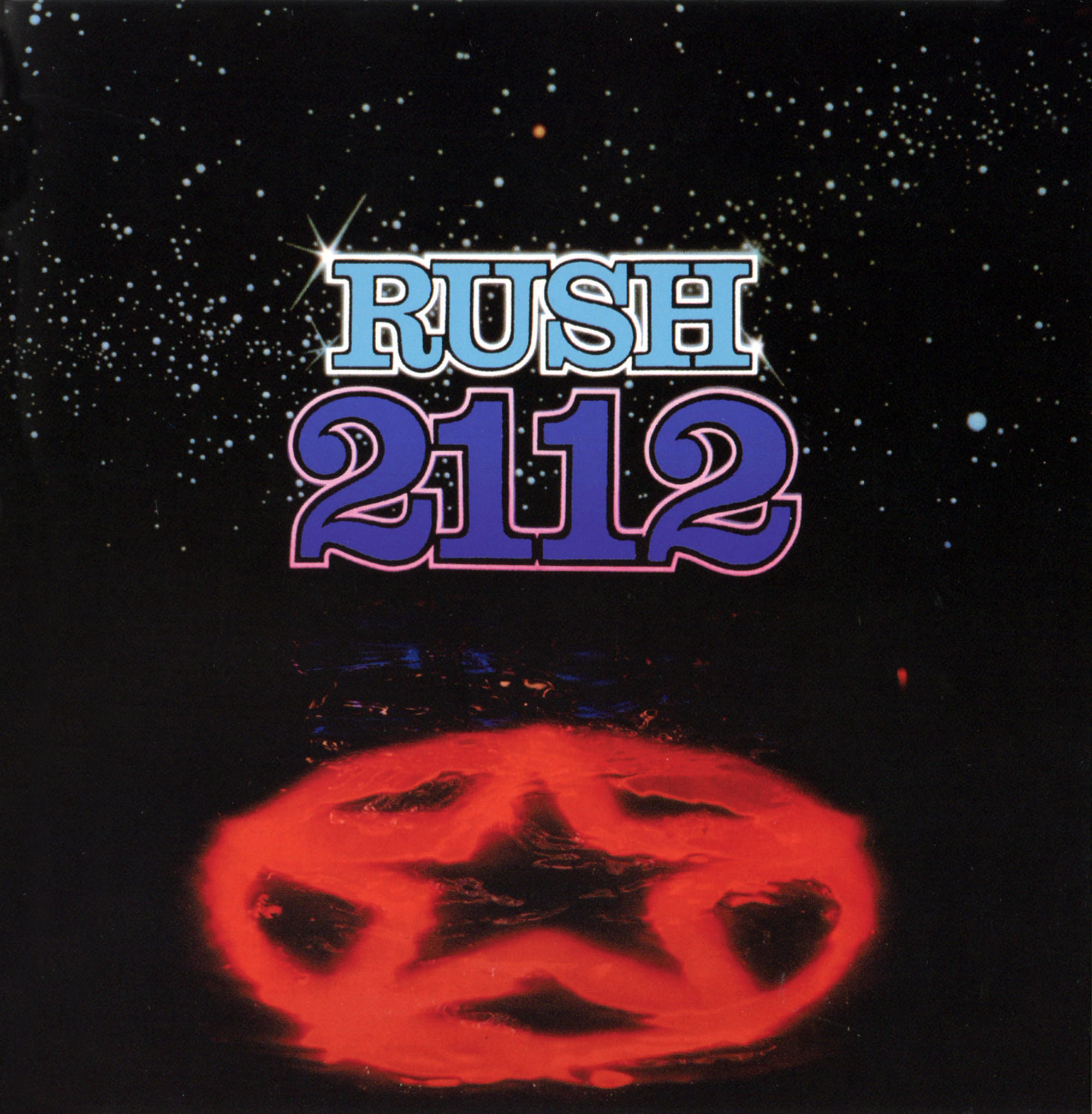 |
| The cover of Rush's 1976 album 2112 |
So, during my long commute to work today, I had a thought. The thought was brought about by the fact that for the last two days, I’ve been listening to Rush’s 2112, A Farewell to Kings, and Hemispheres all in sequence on my ipod (It was free! I won it! I can’t just not use it! proceeds went to AIDS!).
Anywho, the thought was this: why hasn’t anyone tried to jump on the “let’s write a poorly scripted musical based on popular music by a band that everyone loves” bandwagon using the music of multi-platinum Canadian prog-rock power-trio Rush?
Well, I saw “We will Rock You,” the poorly scripted musical based on popular music by Queen about a year ago and was struck by how easily a musical can become a hit by coming up with a pointless plot in order to loosely string together popular songs.
I am inspired by the fact that Rush’s epic songs actually have a plot of their own, courtesy of Neil Pert’s lyrics. I realized that it wouldn’t be too hard to connect the 20 minute “2112″ with the approximately 30 minute “Cyngus X-1″ duology. that’s almost an hour of music right there. Throw in some dialogue, and a couple of other songs and you’ve got yourself a decent musical. So, here, for your pretend-enjoyment, is a mock-up plot synopsis of a hypothetical “2112: the Musical.”
Act I:
The not-so-distant future: Man is on the technological verge of intergalactic space-travel, but no life outside of earth has been discovered as yet. The black hole of Cygnus X-1 in the constellation of Cygnus is found to be sending X-rays through the galaxy. One of the scientists who discovers the rays becomes obsessed with the possibilities of a black hole emitting anything at all, and endeavours to travel to the black hole and investigate. When he gets within distance of the black hole, he is sucked inside, and compressed by the gravity of the vaccuum.
Back on earth, the technological advancement of certain countries has lead to a space-race, spurring international warfare. As the death-toll rises, the world’s artists and visionaries attempt to destroy all advanced technology, fleeing into outerspace in hopes of finding their own private Xanadu (as prophesied by Coleridge?).
Thus ends act one, as the survivors on the planet earth are left without technology, barbarous and chaotic.
Act II:
The year is 2112, and the people of earth have taken what little technology they could salvage and recreated a civilization under the totalitarian rule of the priests of Syrinx, who have built temples everywhere, and eliminated all forms of expression but those they deem acceptable to their plan. One man working in an assembly line escapes his factory and takes refuge in a cave, where he discovers a guitar. Unaware of what it is, he teaches himself to play it, and discovering the power of emotion through music, he realizes that the people of earth (and the solar federation) are missing emotion from their lives. So, he presents his guitar to the Priests, thinking that they will welcome the uniting force of music, but they unexpectedly destroy it, and send him on his way.
He returns to the cave, and in a dream meets an oracle, who shows him a vision of the past, in which an elder race lived happily after travelling to Xanadu, where they’ve continued to explore open-minded behaviours for generations. The oracle says that one day, they will return to destroy the temples of Syrinx. On awaking, the man is so depressed by the state of affairs, believing his dream to be an illusion, that he kills himself. However, as civil wars break out in the solar federation, the elder race returns from Xanadu, alerted by the sound of the guitar, and assumes control of the Solar federation.
The act ends with the outbreak of a war between the passionate elder race, or the Dionysians, and the logical, emotionless people of the Solar Federation, or the Apollineans.
Act III:
As the Apollineans and Dionysians fight, the spirit of the scientist from Act I is sent through the blackhole and through time, back to earth where the people are warring. Seeing the chaos, he cries out for them to stop, and they suddenly realize that they require balance to co-exist. They christen the spirit Cygnus, god of balance, and he teaches them that a balance of heart and mind will mold a new society that is closer to the heart…
The End.
Yep. It’d kick ass.
You get a full cast recording of “Closer to the Heart” as a finale.
Tell me that wouldn’t kick ass.
Yeah, it’d kick ass.
Now, who wants to help me ask the members of Rush to produce?
Monday, June 16, 2008
Where my Au20 gold discs at, fuggah?!
I've come to the conclusion (it was not hard to come to) that I am an audiophile.
Quoth wikipedia: "An audiophile, from Latin audire "to hear" and Greek philos 'loving,' can be generally defined as a person dedicated to achieving high fidelity in the recording and playback of music."
To be clear (for clarity is prized), I have a greater appreciation for music that sounds as close to the original source material as possible.
Human ears are a highly sensitive stereo system.
Quoth some random university's website:"A reasonably standard definition of audible sound is that it is a pressure wave with frequency between 20 Hz and 20,000 Hz and with an intensity above the standard threshold of hearing."
I'm not sure whether that refers to the perceived loudness, or the actual frequency at which the waves wobble (the difference being that higher frequency wobbling means a more "treble" oriented sound, while a lower frequency wobbling means a more "bass" oriented sound... Pretty much anyone who listens to music with more than a passing interest knows this stuff).
The important thing to take from what I'm saying is that an audio recording which has higher or lower frequencies cut out or misrepresented, will sound less like it did when it was actually being played by instruments. This kind of thing can be detected because anything that would normally fall within a certain range of frequencies, normally detectable to the human ear which is heard in a recording with misrepresented frequencies is going to sound thinner, tinnier, muffled, or muddy (these are words that smart people actually use to describe sound).
Now, an audiophile, being concerned with hi-fi recordings is going to want to hear a recording that can represent the entire range of frequencies that were originally being produced by say, a four piece band. This doesn't sound like it should be that hard. If you're like me, you listen to CDs and mp3s all the time thinking "this is pretty darn great." If you're also like me, though, you can certainly tell when someone's sent you a shitty-quality mp3, with a subpar bitrate (128 is considered normal... but is it?), and a lower frequency than your device or file was meant to be heard at.
Here's the problem: CDs as we know them are not normally capable of representing the full range of frequencies, and a vile thing known as "compression" has caused many a recording's range of frequencies to be "compressed" by shaving off the higher and lower frequencies (which admittedly, does not usually result in unsatisfactory listening) with two purposes: to fit audio onto a CD, and to decrease dynamic range to avoid clipping.
Why compress?
Quoth wikipedia (again): "The trade-off of slightly reduced audio quality is clearly outweighed for most practical audio applications where users cannot perceive any difference and space requirements are substantially reduced. For example, on one CD, one can fit an hour of high fidelity music, less than 2 hours of music compressed losslessly, or 7 hours of music compressed in MP3 format."
For the sake of useful redundancy: The standard CD can hold only 800MB (at best). This means that in some cases, a lossless recording of an album won't fit. This doesn't apply to the usual pop-album, which contains between thirty and fifty minutes of material (a rip-off considering the potential 80 minutes of writeable surface). Other albums, though, that take full advantage of the CD space, require compression*. However, the result is something unnatural. The result does not actually sound the way the recording sounded before it was recorded.
Over the years, mastering engineers and producers have figured out how to use compression to reasonable effect without causing noticeable losses to quality, through the use of computer algorithms which encode a lossless recording (typically a .wav format) into a coded lossy format like mp3, or even a lower quality wav.
Now, there's a whole other kind of compression which causes even more trouble. I mentioned that compression is used to modify the frequencies of a sound. Frequently, in remasters of releases that were originally vynil releases, loudness is an issue. We have grown accustomed to a certain level of loudness, which is much louder than what was common during the age of vynil. The process of digitally compressing say, a drum track allows for the drums to seem louder, without having an amplitude that would cause clipping. Clipping is what happens when audio becomes so loud as to be distorted. Compression avoids clipping, but at the cost of dynamic range - which means that the difference in volume between the sounds in a recording is smaller. The result of using too much compression for this purpose is that the brain has more trouble distinguishing between sounds, and some frequencies end up being lost in the mix - so you don't hear everything that was recorded.
So, for audiophiles (who tend not to enjoy pop albums anyway), we encounter problems when we listen to modern CDs that have compression (and for some, all CDs), and when we listen to CDs that were mastered before engineers had quite figured out how to do it best.
The solution? vynil.
The gramaphone or phonograph record is the solution. Somehow, through the miracle of analogue recordingsound wave is etched into the vynil disc. We see this in the form of the groove, which we put the needle into. If we could zoom in super-close, we'd see a wiggly sound wave (they look like this!). The groove, though tiny, can represent the full dynamic range of frequencies in the actual sound to the recording. So, why don't we always listen to vynil? After all, the capacity of vynil is actually limited to the amount of space on the disc. The spiral can only go around so many times before you run out of room. How much room does a record have? About 45 minutes in total. How many minutes is the average pop-album? About 45 minutes. the quality of the original recording is maintained. Here's how: when records are pressed, the actual

Well, vynil is fragile. It can warp, deteriorate and scratch. Worst of all, if anything manages to make the tiniest dent in the groove, then the sound wave at that point is permanently affected by whatever has happened to it. A piece of dust can get in the groove, and you get a pop or a click. Any thing that the needle of your record touches will be picked up by the amplifier. Any abnormal bend in the sound wave is going to be heard, and there's nothing you can do to fix it. Not to mention the fact that flipping the damn thing over is a bit of a chore...
That said, I think we need a bit of an example to show how vynil is/can be superior. In the early days of the CD, audio compression was a new and complicated thing. For one thing, computers were ASS. We're talking early/mid 80s, here. Tech-savvy artists were trying to convert their standard vynil releases to the new and exciting CD medium, which was smaller, didn't scratch as easily (no clicks or pops!) and you didn't even have to flip it over.
One such artist was Frank Zappa. Zappa fans (who are almost exclusively audiophiles for some reason), know that there were several albums that ended up getting mixed very badly for the CD reissue of their vynil favourites. Specifically, Shiek Yerbouti, Tinseltown Rebellion, and You Are What You Is. The masters for these albums were revisited and compressed for the CD releases. The result was horrible. The worst offender was You Are What You Is, which had so many problems that a guitar solo ended up being cut out, there were random volume spikes, and other issues that could cause average listeners headaches.
Later on, the album was re-remastered using the original master tapes, and everything was fine again... but in the end, the real audiophiles all went back and searched out the vinyl.
Unfortunately, audiophiles (and shitty DJs and hipsters) seem to be the only people keeping the vynil industry alive. Very few artists release their albums on vynil these days (more on this later). What alternative is there to vynil for those of us who don't want to send our valuable energy off into the entropic void by flipping the record over?
Solution: Lossless audio codecs.
Like I said before, there are lossless digital formats, like PCM (.wav). For computer users, if they have the capabilities, it is possible to rip lossless recordings from CDs (if those CDs are lossless themselves, otherwise, you're just encoding a lossy file without any further loss). Furthermore, if you don't mind having cables all over your floor, you can run a vynil turntable through your line-in (basically an all-purpose input) port in the back of your soundcard. Using audio programs, you can record the entire album in a lossless format.
But, what do we do about compressed CDs when vynil isn't available? Well, there's a bit of a movement going on that could be of some help.
With the dawn of the digital release, music artists are able to distribute the high-quality media files directly to you. Trent Reznor of Nine Inch Nails has partially pioneered this method of album release, letting his listeners download 320kbps mp3s (that's better than CDs), FLAC (almost lossless, but not quite), and wav (all lossless).
Not to mention the fact that SACDs, DVD-A, and Blu Rays have the kind of space you'd need to not only present the highest quality stereo version (which is the normal way to hear things with your ears), but also in surround sound! Yes, surround sound! the ridiculously unnecessary audio experience that lets you hear the music from anywhere between 3 and in some cases 10 (but usually 5.1) different locations. If you've got it set up right, it's supposed to sound like you're there with the band. I'm a fan of surround, but the lengths to which I will go to hear the band as if I was there are limited.
Anyway, with the increasing capacity of portable music devices, and the fact that you CAN burn lossless audio to CDs, even if the commercial CD release wasn't released in a lossless format, it seems that there will be (and are) audiophiles wandering around listening to hi-fi recordings on mp3 players.
However, in my view, vynil will always be the best choice.
*this is worded a bit incorrectly. It's not the case that 80 minutes of music is available to be written, but based on standard wav encoding and filesizes, 80 minutes is the standard for a lossless PCM format.
Monday, May 12, 2008
Guitars make noises, and then ladies make panty-mess.
I’m a guitarist of sorts (as evidenced by the nifty video down at the bottom of this post). I’ve been playing since I was 16. I’m completely self-taught. In most circumstances, that would mean that I’m terrible at the guitar. If I may blow my own trumpet, however (pluck my own guitar?), I’m at least above average.
It interests me though, that now, after years of playing it by ear, I can pick out five of my main influences in guitar playing. Most people will cite Ywngie Malmsteen, Joe Satriani, one of those insane people from Dragonforce, or Eddie Van Halen. I suppose that my apparent inability to ‘shred’ and my half-assed ‘tapping’ is probably what keeps those folks off of my list.
So, here’s my top five most influential guitarists, with respect to my own personal style.
1. Frank Zappa
This man’s guitar prowess was relatively overlooked by guitar fans. This is probably because of his tendency for the angular, polyrhythmic, dissonant, and unstructured. Having been influenced largely by both the blues guitar and german avant-garde classical music, the fusion of the two would no doubt be somewhat jarring for most listeners, particularly those who had grown used to Jimmy Page in the 70s.
Anyhoo, Zappa had this way of playing guitar that was described (by himself, I think) as building a sound-sculpture. He improvised a lot, and it wasn’t standard riffs he pulled off, it was oddly melodic and never repetitive. I take a large part of my influence from Frank Zappa. His solos were some of the first I heard, and his improvisation style is something I’ve been working on for quite some time. Also, his use of the whammy bar is pretty crazy. Check out: “drowning witch,” “watermelon in easter hay” and the solo in “Zomby Woof.”
2. Adam Jones
I like tool. I like tool a lot. Apart from the polyrhythms and non-standard time-signatures, one of the main intrigues for me is Adam Jones’ playing. The main thing about it is that, when I first started out on the electric guitar, I wanted to play along with tool. At some point (I wasn’t even playing tool at the time) I managed to learn how to make pinch-harmonics. Pinch harmonics are a somewhat complicated technique (particularly if you don’t play with a pick) which involves brushing the string with your thumb as its being plucked.
Jones uses pinch harmonics in some of his best solos. If you’re looking to hear some good examples, I would suggest either “Lateralus”, or “Parabola” from the album Lateralus. Both of those songs feature some pretty awesome pinch-harmonics, and I’ve been influenced strongly by their style.
3. Trent Reznor
Not many would consider Trent Reznor to be a great guitarist (least of all himself), but there’s a certain raw “all over the place” style that always blows my mind when I hear it. There are a great few Reznor guitar solos recorded, but my favourites appear in the following songs: Nine inch nails’ “Deep,” “We’re in this together now,” and Jakalope’s “Feel it” (Actually, I don’t know if that’s him playing that solo, but I like it anyway). For the most part, I find it hard to play along with Reznor solos (and often his standard rythm riffs) because they’re just so elsewhere.
4. Johnny Greenwood
Radiohead’s lead guitarist Johnny Greenwood is an interesting guitarist, to say the least. He’s a classical composer, and a spokesperson for the little-known electronic instrument the Ondes Martinot. His playing style is characterized by a sense of strain. Speaking of which, I hear he has this special wrist-support dealie that he wears in order to continue playing with such a strain. His guitar tends to come in a gentle flow, which is followed by bursts of intense energy. Some of his best solos are in the radiohead songs “Paranoid Android,” “Just,” and “there there.” I don’t sound much like him when I play, but in some of my more caffeinated moments, I’ve been known to get close.
5. Larry Lalonde
Ler’s a bit of an odd choice for me. I’ve always loved Les Claypool’s bass-playing, but over and under that was always Larry Lalonde’s dissonant, noisey whine. Since Zappa is one of Lalonde’s main influences as well, it’s no surprise that I would enjoy his work as well. As always, whammy bar, angularity, and lack of structure are a main influence of mine from this guy. Some of my favourite Larry tracks from Primus: “Profesor Nut Butter’s House of Treats,” “Bob’s Party Time (Live… from Rhinoplasty),” and “Tommy the Cat” (Those are all awesome claypool tracks too, by the way).
Anyway, those are my top five favourite and most influential guitarists, and a few standout tracks.
I encourage you to give them a listen…
And here's a video for you, so you can give me a listen (for comparative purposes... maybe).
It interests me though, that now, after years of playing it by ear, I can pick out five of my main influences in guitar playing. Most people will cite Ywngie Malmsteen, Joe Satriani, one of those insane people from Dragonforce, or Eddie Van Halen. I suppose that my apparent inability to ‘shred’ and my half-assed ‘tapping’ is probably what keeps those folks off of my list.
So, here’s my top five most influential guitarists, with respect to my own personal style.
1. Frank Zappa
This man’s guitar prowess was relatively overlooked by guitar fans. This is probably because of his tendency for the angular, polyrhythmic, dissonant, and unstructured. Having been influenced largely by both the blues guitar and german avant-garde classical music, the fusion of the two would no doubt be somewhat jarring for most listeners, particularly those who had grown used to Jimmy Page in the 70s.
Anyhoo, Zappa had this way of playing guitar that was described (by himself, I think) as building a sound-sculpture. He improvised a lot, and it wasn’t standard riffs he pulled off, it was oddly melodic and never repetitive. I take a large part of my influence from Frank Zappa. His solos were some of the first I heard, and his improvisation style is something I’ve been working on for quite some time. Also, his use of the whammy bar is pretty crazy. Check out: “drowning witch,” “watermelon in easter hay” and the solo in “Zomby Woof.”
2. Adam Jones
I like tool. I like tool a lot. Apart from the polyrhythms and non-standard time-signatures, one of the main intrigues for me is Adam Jones’ playing. The main thing about it is that, when I first started out on the electric guitar, I wanted to play along with tool. At some point (I wasn’t even playing tool at the time) I managed to learn how to make pinch-harmonics. Pinch harmonics are a somewhat complicated technique (particularly if you don’t play with a pick) which involves brushing the string with your thumb as its being plucked.
Jones uses pinch harmonics in some of his best solos. If you’re looking to hear some good examples, I would suggest either “Lateralus”, or “Parabola” from the album Lateralus. Both of those songs feature some pretty awesome pinch-harmonics, and I’ve been influenced strongly by their style.
3. Trent Reznor
Not many would consider Trent Reznor to be a great guitarist (least of all himself), but there’s a certain raw “all over the place” style that always blows my mind when I hear it. There are a great few Reznor guitar solos recorded, but my favourites appear in the following songs: Nine inch nails’ “Deep,” “We’re in this together now,” and Jakalope’s “Feel it” (Actually, I don’t know if that’s him playing that solo, but I like it anyway). For the most part, I find it hard to play along with Reznor solos (and often his standard rythm riffs) because they’re just so elsewhere.
4. Johnny Greenwood
Radiohead’s lead guitarist Johnny Greenwood is an interesting guitarist, to say the least. He’s a classical composer, and a spokesperson for the little-known electronic instrument the Ondes Martinot. His playing style is characterized by a sense of strain. Speaking of which, I hear he has this special wrist-support dealie that he wears in order to continue playing with such a strain. His guitar tends to come in a gentle flow, which is followed by bursts of intense energy. Some of his best solos are in the radiohead songs “Paranoid Android,” “Just,” and “there there.” I don’t sound much like him when I play, but in some of my more caffeinated moments, I’ve been known to get close.
5. Larry Lalonde
Ler’s a bit of an odd choice for me. I’ve always loved Les Claypool’s bass-playing, but over and under that was always Larry Lalonde’s dissonant, noisey whine. Since Zappa is one of Lalonde’s main influences as well, it’s no surprise that I would enjoy his work as well. As always, whammy bar, angularity, and lack of structure are a main influence of mine from this guy. Some of my favourite Larry tracks from Primus: “Profesor Nut Butter’s House of Treats,” “Bob’s Party Time (Live… from Rhinoplasty),” and “Tommy the Cat” (Those are all awesome claypool tracks too, by the way).
Anyway, those are my top five favourite and most influential guitarists, and a few standout tracks.
I encourage you to give them a listen…
And here's a video for you, so you can give me a listen (for comparative purposes... maybe).
Practising the Janey Solo from Rab Townsend on Vimeo.
And now, a message from the future: at some point, I made a videoblog regarding this subject with most of the bands here having audio examples. Post on that will come soon.
Tuesday, May 6, 2008
Album Review: Ashes Divide – “Keep Telling Myself It’s Alright”
 |
| Ashes Divide - Keep Telling Myself It's Alright |
Billy Howerdel began as a guitar tech for tool, which led to his association with Maynard James Keenan, and the formation of A Perfect Circle, a supergroup with music composed by Howerdel, and lyrics and vocals by Keenan.
Together, they produced two albums, and one (somewhat mediocre) cover-album of anti-war songs, released to coincide with the 2004 election. With the immanent release of tool’s 10,000 Days MJK had to return to his original band, leaving Billy with the time to write new music for his own solo project called ASHES dIVIDE.
Fans of A Perfect Circle will find more common ground between Ashes Divide’s Keep Telling Myself It’s Alright and APC’s first album Mer de Noms than with their later material. For those who like their alt-metal harder than it is progressive, this will be a positive attribute.
KTMiA (as I shall now refer to it) is strong first solo effort, which is to be expected from the composer behind such classics as the APC tunes “Judith” and “Weak and Powerless.” It is clear that Howerdel’s composition and arrangement are the backbone of all of his musical efforts.
That said, having grown accustomed to MJK’s powerful voice, it is somewhat jarring to be confronted with Howerdel’s somewhat more mainstream style of singing. His dynamics are less apparent, and he leans toward the more awkward tones of popular punk-rock, on what may seem a few too many occasions. This shouldn't be a problem for newcomers, or for those who are willing to take the time to grow into Howerdel’s new musical voice.
Standout Tracks: Defamed, Enemies, The Stone
The album’s opener “Stripped Away” drags a little. Its pace is powerful but slow, and in that sense, it does not immediately grab one's attention. It isn’t until the bridge that the energy of the song is truly conveyed to the extent that it ought to be. The heavy guitars drop out, and Howerdel’s voice wavers with the strength of his vocal performance, recalling Freddie Mercury, in a faint sort of way. Unfortunately, this demonstration of ability is only a brief respite from what is an otherwise drab song.
“Denial Waits” begins in a plaintive lyrical moan by Howerdel, over a quick beat by super-drummer Josh Freese. Before long, the emotional rawness we should have been hearing in the previous track appears somewhat abruptly, but welcome nevertheless amid a powerful blast of music.
“Too Late” is another heavy slow-mover, but its melancholy verses don’t feel draggy like they did in “Stripped Away.” Musically, it's an appropriate mish-mash of the styles found on APC's first two albums. However, in this song, we see a first example of where Howerdel’s composition exceeds his vocal prowess to a detrimental effect. After a typically good Howerdel guitar solo, a great musical bridge emerges, but it's dragged down by poor lyricism and just as poor singing by Howerdel
“Forever Can Be” is another melancholy slow-mover (there appear to be a lot of these). Its chorus is given some grounding by a piano melody that matches the melancholy tone. As if to make up for the icky bridge in “Too Late” the lyrics of the chorus are more interesting: “Forever can be something to believe in. This was one of those times.” It suggests disappointment, and failure, despite optimism. Interspersed throughout is an intriguing little guitar melody which has east-asian hints, or perhaps medieval elements, which add some flavour to the first real ear-catching track on the album.
“Defamed” almost sounds like a rock cover of The Postal Service. The chord progression is light and minor, but hopeful. The lyrics are a little silly considering the weight of the previous songs’ content. Despite this, the song is cohesive, and catchy. Its upbeat tempo and strong drum-work by Freese make it danceable and contribute to what is ostensibly a great rock song.
When the allmusicguide refers to “Enemies” as overeager, one can see why, given its introductory guitar riffs. However, heavy punk drums and the return of that style of emotion-laden power-vocals mean that “Enemies” is going to be a fast-paced ass-kicker of a song. The key-change in the latter half of the song is particularly engaging.
“A Wish” seems noodly at first, with a simple piano melody and sporadic drums, which build into a cohesive roll. Billy’s close-mic’d vocals are low and wispy. The lyrics are simple and personal, without collapsing too far into purple prose. The groove maintained by the drums, and the piano melody hold the song together for its short duration.
“Ritual” takes a similar approach, vocally, to “A Wish.” A mysterious set of counter-melodies gives this one a little more to chew on for listeners. Without much difference between this and the previous song, musically, it maintains the melancholy mood with some more good music.
At last, the single “The Stone” follows, with a somewhat clichéd intro that bursts into yet more clichéd, but faster riffs (cool dissonance notwithstanding). Freese’s driving beat helps build anticipation of the chorus, which is a dramatic burst of swelling guitars that borrow (if only subconsciously) from film scores. Unfortunately, after hearing the chorus, the following verses make one impatient at having to wade through them before the chorus returns. Despite that, the chorus of "The Stone" carries the song (and perhaps even the the whole album) by it’s sheer might. Yes, might.
“The Prey” feels more electronic than any other track on the album, borrowing some of its melodic style from the mainstream. An interesting feature of the track is a slightly detuned, high-pitched guitar line which plays intriguing little melodic riffs over top of the rhythm tracks and vocals. It works as a strong counter-point to Billy’s vocals. The mood of the song is more of joyous than any of the other tracks.
The final track “Sword” has a dissonant piano melody as its intro, with a subtle cello (which grows to become less subtle) just underneath. The cello switches to the top of the mix, sounding vaguely offkey over the piano’s dissonant tones. The intro gives way to a driving, throbbing bassline which recalls the Tapeworm toss-away “Passive” that was released on APC’s cover-album eMotive. The entire song takes this approach, and hits hard, throbbing and driving until it all drops away about five minutes in revealing a gentle vocal line over top of the same introductory piano melody, which sounds more beautiful the second time around.
Monday, May 5, 2008
Album Review: Architecture in Helsinki – “Fingers Crossed”
 |
| Fingers Crossed by Architecture in Helsinki |
I remember I first heard of this band through Amazon’s “You might also like…” pages. I downloaded 3 tracks, just to see what they were like. The songs were, “Imaginary Ordinary,” “Like a Call,” and “Do the Whirlwind.” Two of those songs are on “Fingers Crossed,” and I immediately liked them because they had a childlike playfulness hidden behind their instrumentation and their vocals that was very compelling. (I've since learned that this style is referred to as "twee pop" in some circles).
The first song on the album is an instrumental called “One Heavy February” and as soon as it begins, you can tell you’re going to be in for some short, carefree pieces of music with a sweetness that you can’t help but love. That's just what you get with the entrance of the female vocals on the following track “Souvenirs” coming in with some childlike “lalala” action before segueing into some poetic lyrics that speak nostalgia.
The knuckle-drag of “Scissor Paper Rock” and “To and Fro” are a bit of a let down, after such an upbeat beginning, but the fun returns with the prophetic “Spring 2008″ which works as a good preparation for the bubble and pop of the album’s stand-out track “Owls Go,” a fast-paced, but innocent song, whose verses are peppered with alternating shouts and whispers of “Owls Go!” And with a charmingly deceptive chorus sung by the female vocalist “Finding a replacement with a heart sedated, I’ll forget you/Attic in the basement with a knife serrated, I’ll protect you.” Who knows what it means? It’s oddly sweet.
“Kindling” is another up-beat, building tune, whose tendency for the epic is surprising, considering it’s less than two minutes long. Its horns are powerful. Following “Kindling,” the album seems to wind down, with the slower paced “It’s almost a trap” and “Like a Call,” leading into the beautiful and simple duet “Where you’ve been hiding.”
“City Calm Down” seems like a lullaby, and works as a counterpoint to “Owls Go,” reprising some its musical motifs, and asking us to calm down, before it gains momentum and takes on a symphonic quality, building to a climax that drops off at the end.
The final track “Vanishing” is a favourite of mine, with the simple lyric “Is this a fling? It’s [been] seven days and you’re already vanishing.” It begins in a similar fashion to the album opener, with a bouncy, somewhat optimistic sounding instrumental theme before easing out into a slow, contemplative movement. The question asked in the lyrics forebodes a broken heart, but the music is laced with hope and optimism, as though the question were asked with fingers crossed...
Thursday, May 1, 2008
No Label, No Problem
This is old news, but here it is for posterity.
Originally published in MacMedia Magazine
No doubt many of you have heard about Radiohead releasing their new album In Rainbows online as a digital mp3 download for whatever price you thought it was worth. To many this seemed to be a marvellous step forward in combating both tyrannical labels and music piracy – simultaneously catering to the age of digital music distribution. Of course, little did anybody know that the band had secretly planned to release the album later through a major label on CD (presumably for the usual high price determined by that label). What appeared to be an honest ‘eff you’ to the system, turned out to be a marketing ploy, and perhaps even a case of cheating fans out their money (some poor people paid hundreds of dollars as a sign of support).
Then, Trent Reznor (you know, that NIN guy) and up-and-coming spoken word/hip-hop artist Saul Williams did the real deal. They released their (amazing) collaborative album for free with higher quality than Radiohead’s downloads, no strings attached, and giving the option to pay 5 dollars in support of the artists. I think there are two main reasons why artists have turned to self-distribution in a digital format.
The first reason is probably somewhere near you right now: your mp3player or iPod (I’ll just call them all iPods from here on, for convenience’s sake). It is clear to me that we have reached a stage at which it is impossible to live without digital music. Since Napster, we’ve been using our computers as jukeboxes, and with Apple’s help, we can carry those jukeboxes around. However, a large problem was created by these technologies: piracy. Sure, we had the mix-tape problem in the 80s, but once it came to CDs and the Internet, the sheer scale of the problem made the blank-tape tax seem like a drop in the bucket. Now that the damage is nigh irreversible, it’s only logical that the fumbling record labels would join us after failing to beat us.
In this age of the mp3, we face a burgeoning frontier of music marketing. The labels want to keep you from stealing music so they can make huge bucks, and the artists want to get heard by as many people as possible without losing money. After recognizing that money could still be made on the Internet, the labels and Apple got together and formed the iTunes Store as a way of allowing the music industry (mostly the Recording Industry Association of America or RIAA) to make you pay for songs that you would otherwise have acquired illegally. Of course, this helps the labels more than it helps the artists. A much larger percentage of the money you spend with iTunes is going to the label, than to the artist (more than is usual, I’d guess, though I couldn’t say specifically how much).
The reason is this: you are not paying for the music; you are paying the label for the ability to hear the music (note that due to copy-protection, many songs are subject to harsh limitations, in terms of sharing and backups). Were you to pirate it instead, you could be sued by that label for sums well outside of your price range– regardless of whether you were someone’s dead granny, or someone’s nine-year-old grandson.
Obviously, some artists are not pleased with the way this system works. Allegedly the Zappa Family Trust had all of Frank Zappa’s material removed from the iTunes store. The action certainly follows from a quote by Frank Zappa himself:
“The manner in which [people] ‘consume’ music has a lot to do with leaving it on their coffee tables, or using it as wallpaper for their lifestyles, like the score of a movie– it’s consumed that way without any regard for how and why it was made.”
I’d venture to say that many artists feel this way. The pop-single mentality, which seems not only to be supported, but also endorsed by iTunes, is the kind of mentality that completely disregards the artistic process, and the effort that goes into making a cohesive album. So, if we are to continue living in an age of digital music distribution, and we want to support the artist, it seems that perhaps we need a better business model than what we have right now.
The second reason for self-distribution follows from that poor model. Artists would love to be heard, and by many, many people. Obviously, they can’t very well distribute their physical albums to the entire world efficiently. They must pay a label to distribute it, allowing the label to set a price (in some cases, unnecessarily high), and further delay their albums without good reason in order to somehow satisfy their label’s wishes. The Internet provides the kind of global market they want, without the money-grubbing middlemen. However, the digital age poses the problem of losing the physical aspect of the album, including the artwork, the lyrics, and obviously the disc itself. However, if the music is all that’s important, maybe people like Trent Reznor and Saul Williams can still get by. Without releasing their album through iTunes, and without going through middlemen, they have released an album with lossless quality, for as much money as an overpriced cup of coffee, or alternatively, for free! Such a low price potentially allows that the casual music pirate might actually consider paying for the album, as a sign of support for the artist. Certainly this is the best way we have to support the artist, and only the artist, in return for giving us some great music.
That said, I do have problems with the self-distributed model. For one thing, I like having the physical album. Here’s a little fact for you: the blank CD-Rs that are sold to us are missing something crucial. Whereas on commercial CDs, there is a lacquer finish over the burned music, increasing both the duration of its fidelity and its durability, blank CD-Rs do not have this lacquer finish, which significantly decreases both. This means, that if I don’t have an iPod, and I want to listen to digitally distributed album in my eight-year-old discman, then I’ll have less chance of maintaining the quality of that recording. I also like having the artwork, and the little booklet with all the lyrics in it. Sure, they can give me a .jpeg or a .pdf file with all of that stuff and more, but there’s something to be said for having an album and its artwork; appreciating it in the context it was made for.
In order to reconcile the physical album with the digital age, I propose a method that I’ve borrowed from Rob Sheridan (artwork designer for Nine Inch Nails). Basically, if we want to support the artists who aren’t ready or able to innovate to the level that Radiohead pretended, or that Saul Williams succeeded, without supporting the greediness of the RIAA, we should simply not buy CDs released by labels under the RIAA. Sure, you’ll be deprived of some good music, but maybe they’ll learn a lesson if enough people try, and maybe, just maybe, the labels and the artists can cooperate in creating a marketable system, that will benefit both the label, the artist, and most of all, the consumer of the digital age.
Addendum: For the record, I did buy the physical release of In Rainbows, and it was worth it. Saul Williams’ Niggy Tardust saw a physical release with added tracks, which made me feel somewhat betrayed, having written this big honking article about how revolutionary the method was. That said, I will buy it. The importance of the physical album is too great to hold grudges about the 5 bucks I spent. That said, I also coughed up five bucks and fourteen more bucks for both the digital and physical versions of Nine Inch Nails’ Ghosts (but there were no secrets about that physical release). To some extent, my desire for the physical album far outweighs any impulse to hear the music as soon as possible, and wherever I am.
Furthermore, at the risk of revealing myself as a hypocrite, I ended up getting an iPod (and later, an iPhone!). It has many flaws (iTunes is crap software - especially on a PC). That said, it makes for good listening when it comes to albums I’ve downloaded because they’re out of print or unavailable… or simply not bought yet. I still carry a box of CDs with me everywhere I go, for stationary listening.
Subscribe to:
Posts (Atom)